
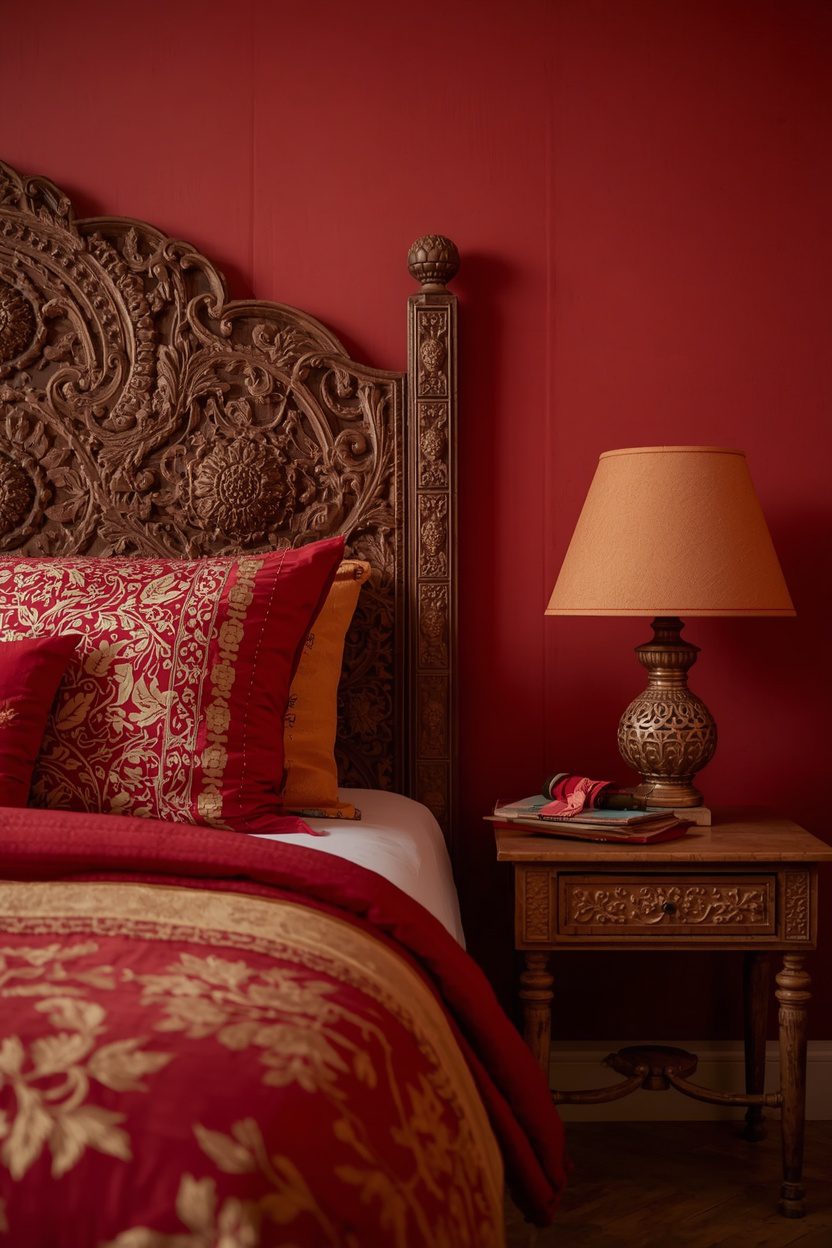
Indian interiors bring together centuries of craft tradition — hand-block printing, carved wood, embroidered textiles, hammered brass — and the bedroom is where these traditions can create a space that reads rich, warm, and deeply personal. These Indian couple bedroom decor ideas draw on those authentic traditions to show how a bedroom can carry real cultural depth without reading overwrought or themed.
Each idea below is a complete, distinct design direction with honest notes on sourcing, colour, and balance so you can use these elements beautifully and in a way that honours their origin. Whether you lean into the full jewel-toned maximalism or pick one or two cultural touchstones to anchor an otherwise calm room, there is a direction here that will make your bedroom genuinely your own.
1. Jewel-Toned Block Print Bedding for Indian Couple Bedroom Decor
Hand block-printed bedding in deep ruby, royal blue, forest green, or saffron with white or black repeat motifs is one of the most beautiful and most authentic ideas here, the hand-stamped pattern carrying the slight imperfection of the block that a machine print never replicates. Traditional Indian block prints use wooden blocks hand-dipped in vegetable dye, so no two pieces are precisely identical.

Source genuine hand-block printed bedding from Jaipur or Ahmedabad artisans where possible, and mix a block-print duvet with solid-coloured pillows in one of the print’s secondary tones to keep the bed rich but balanced.
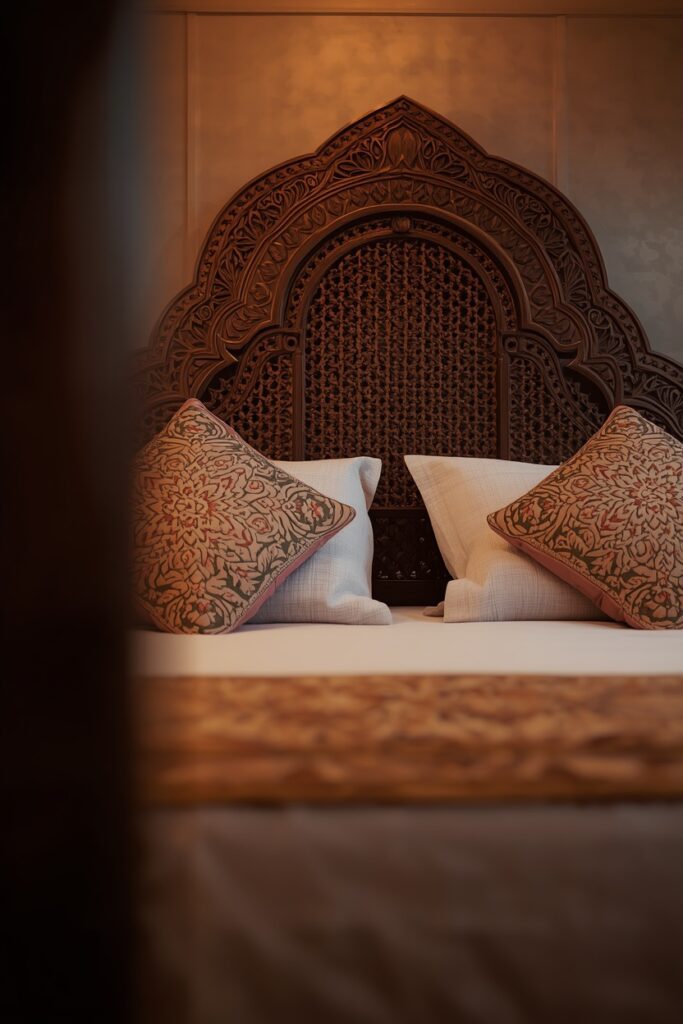
2. A Carved Sheesham or Teak Wood Headboard
A headboard carved from sheesham (Indian rosewood) or teak with traditional jali lattice, floral, or geometric motifs is the single piece that most unmistakably roots a bedroom in Indian craft tradition. The depth of carving and the warmth of the dark timber read luxurious and one-of-a-kind. Position it against a plain, warm-white or warm-greige wall so the carving reads clearly and the timber grain glows without competing with a busy wall treatment. Oil or wax the timber annually so the grain stays rich rather than drying out and dulling.
3. A Mandala Art Feature Wall
A mandala — the circular geometric pattern from Hindu and Buddhist tradition — as a large-scale piece above the bed brings spiritual beauty and visual drama to an Indian bedroom. It can be painted directly onto the wall, applied as a large canvas print, or achieved through a carved wood panel.
A single, large, well-proportioned mandala in a deep jewel tone or in gold against a warm white reads deeply considered and culturally rich without overcrowding the wall.
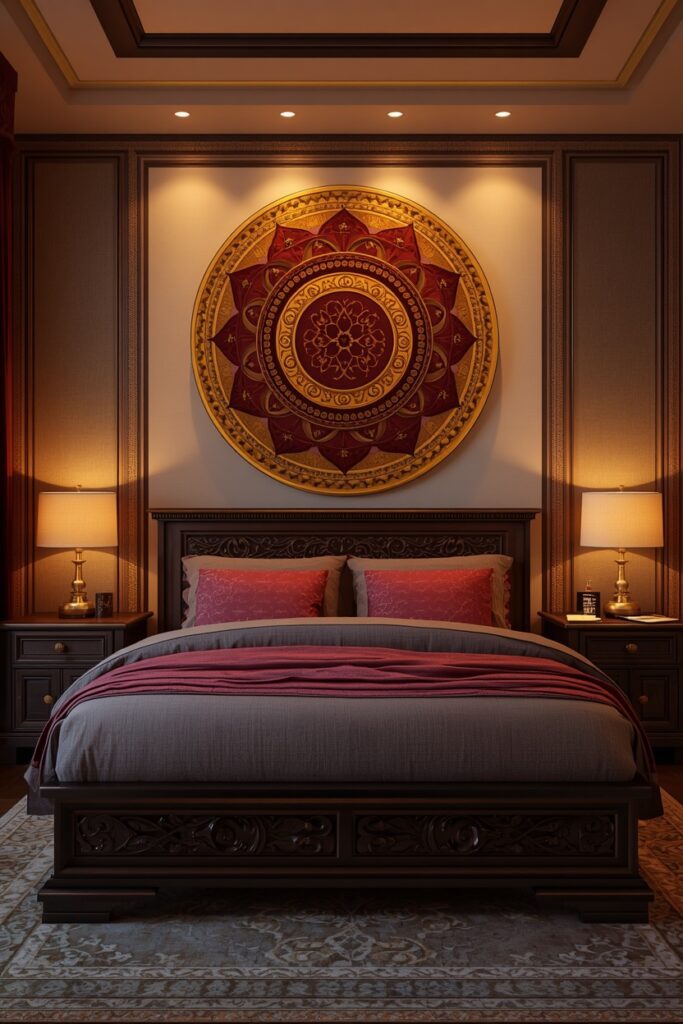
Keep the rest of the room calm so the mandala leads, since a mandala works best with clear space around it.
4. Rich Embroidered Silk Cushions
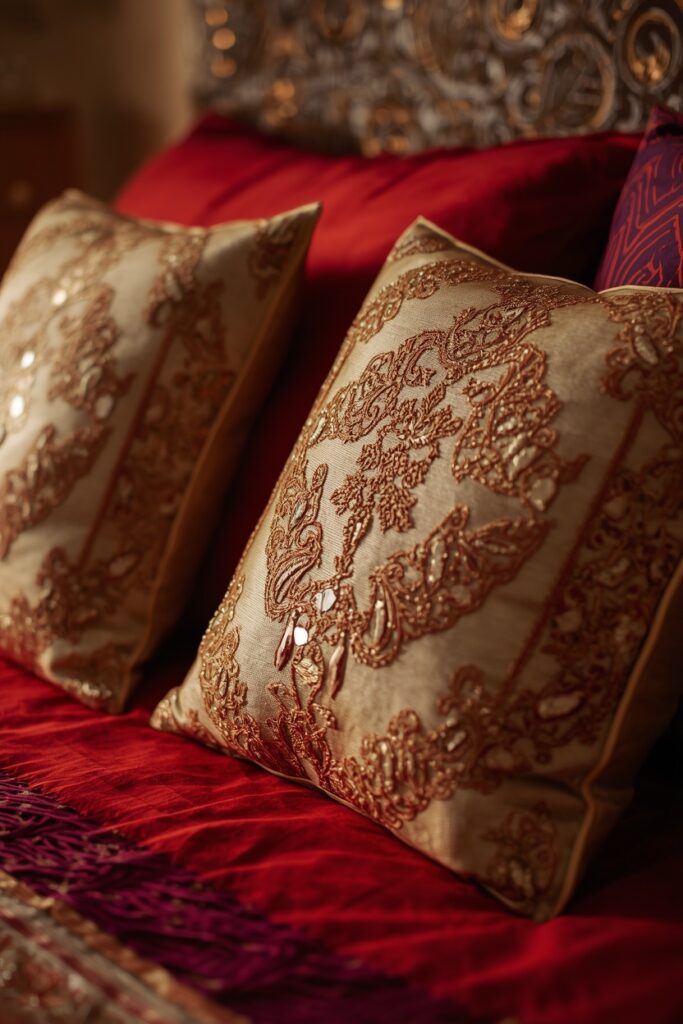
Embroidered silk cushions in zardozi (gold thread), mirror work, or kantha stitching bring extraordinary tactile richness and craft history to a bed and cannot be replicated by any mass-produced equivalent. The goldwork of zardozi, the tiny mirrors of Rajasthani folk embroidery, and the running stitch of kantha quilting are each entirely distinct traditions with centuries behind them.
Mix two or three embroidery types in the same jewel-tone family rather than matching them precisely, since Indian textiles traditionally combine different techniques, and the layered richness is exactly the point.
5. Brass and Gold Accent Decor
Hammered brass — in a vase, a tray, a lamp base, or decorative bowls — is one of the most versatile and most beautiful of all Indian decor elements, the warm gold of handworked brass reading rich and ancient against jewel-toned textiles. Traditional Indian brass pieces are often hand-engraved or etched with floral and geometric patterns. Keep the brass pieces few and substantial rather than scattered and small: a single large hammered tray or a pair of etched brass lamps read more powerfully than ten small objects.
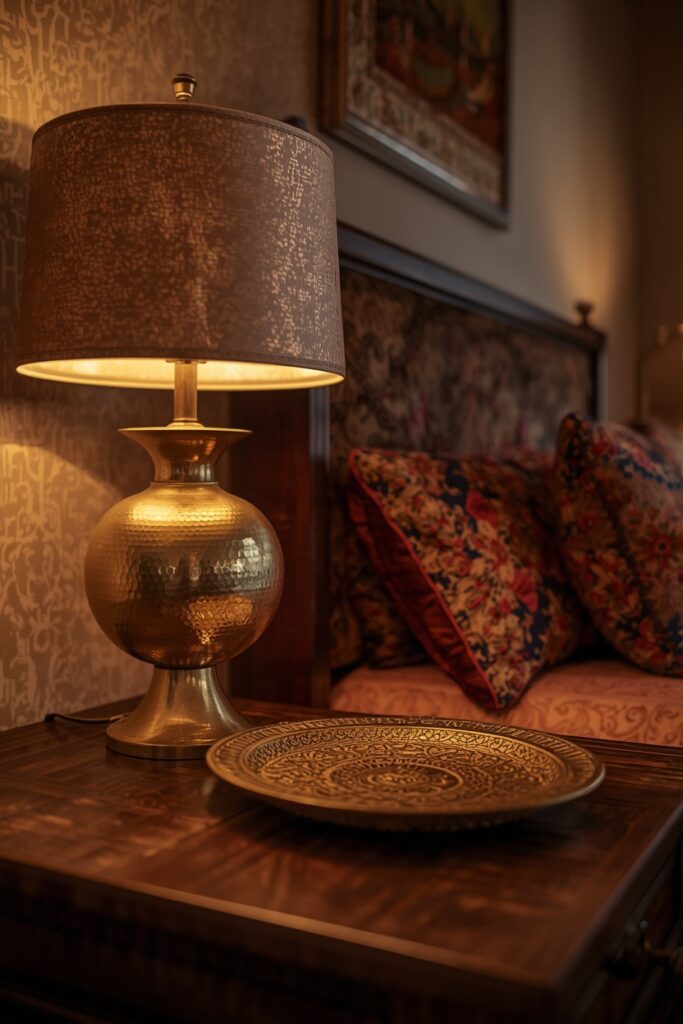
Let them develop a gentle patina rather than polishing them bright.
6. A Canopy Bed with Draped Fabric
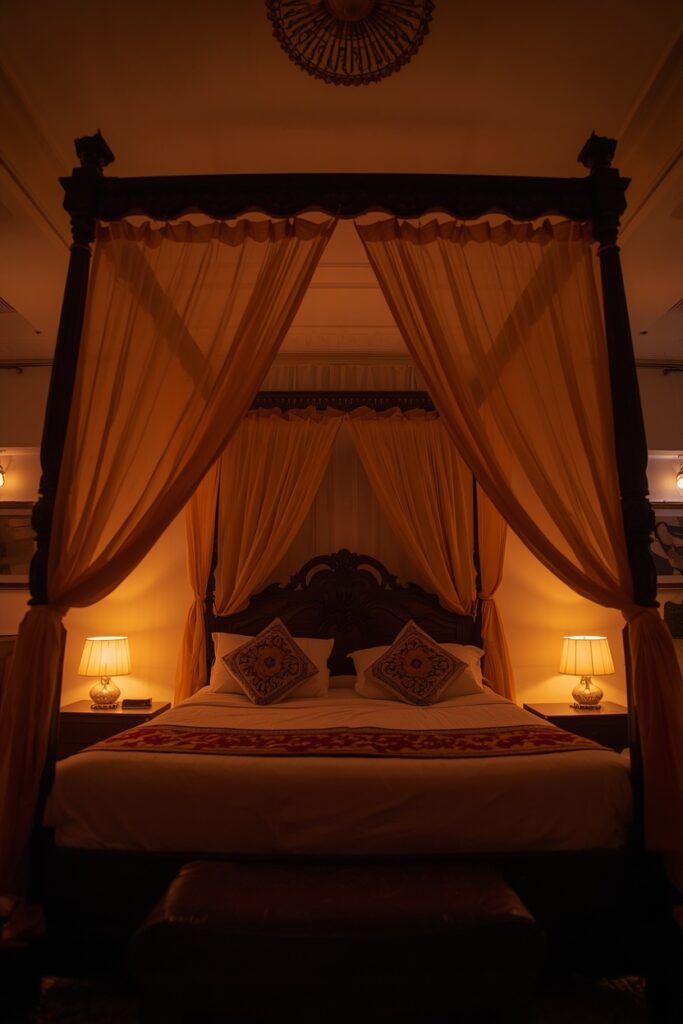
A fabric canopy above the bed — a four-poster draped in sheer silk, sari fabric, or embroidered organza — brings a lush, romantic, princely quality to an Indian-inspired bedroom. Draped fabric canopies appear in traditional Indian palace interiors and bring both visual grandeur and a sense of enclosure that reads intimate and special. Use a lightweight, semi-sheer fabric in a jewel tone or gold so the canopy reads airy rather than heavy, and secure the fabric generously so it drapes in soft folds at each corner rather than pulling taut.
7. A Jali-Inspired Screen or Room Divider
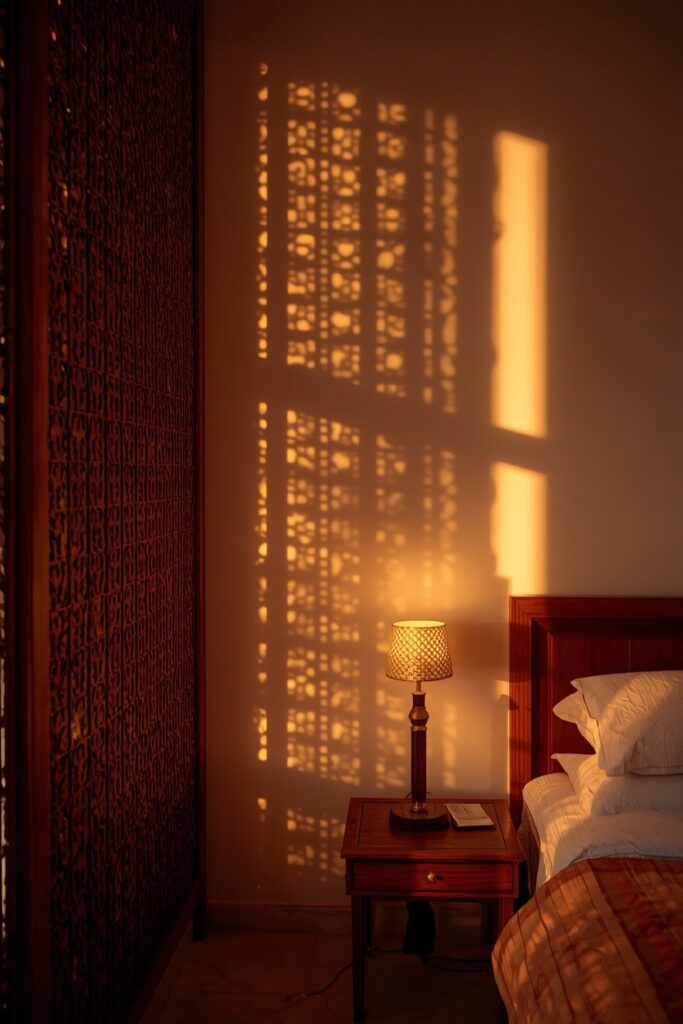
A jali screen — a perforated lattice panel in carved wood or pressed metal originally used in Indian architecture to allow air and filtered light through a wall — makes a stunning room divider, headboard alternative, or window screen in a modern bedroom. The geometric or floral lattice casts beautiful shadow patterns across the walls and floor when backlit or side-lit.
Teak, sheesham, or brass-finish metal are the most authentic materials, and the screen reads most dramatic when the light source is behind it, so position a warm lamp on the wall side to project the lattice shadow into the room.
8. A Traditional Dhurrie Floor Rug
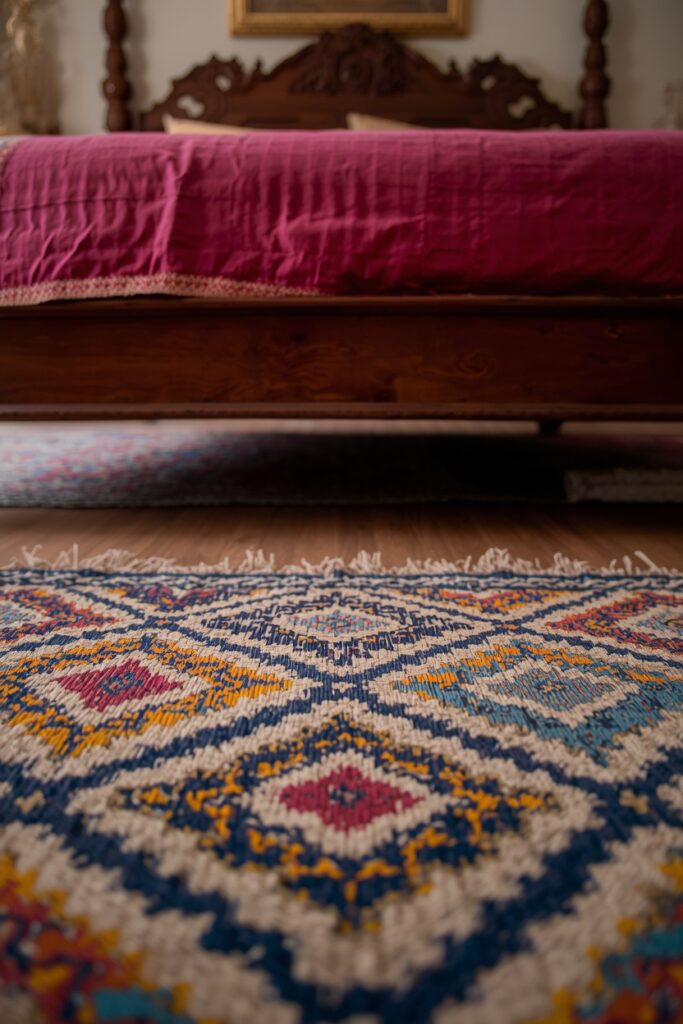
A flat-woven cotton dhurrie rug in the traditional geometric or striped patterns of Rajasthani weaving grounds a bedroom in authentic Indian craft while adding colour and warmth underfoot. Dhurries are woven on horizontal floor looms, which produces the characteristic flat, reversible structure and the clear, graphic pattern. Traditional colours include saffron, indigo, brick red, and forest green in repeating diamond, stripe, or chevron motifs.
A dhurrie is also more practical in a bedroom than a pile rug because it is fully washable, lies completely flat, and does not harbour dust.
9. Paisley and Block Print Pattern Mixing
Traditional Indian interiors layer multiple patterns together — a paisley (buteh) duvet with a block-print cushion and an ikat throw — in a way that reads luxurious and curated rather than chaotic, because all the patterns share the same tonal family and the same scale relationship. The key to mixing Indian patterns is colour discipline: keep all the patterns within one jewel-tone family (all warm, or all cool) and vary the scale between large pattern, medium pattern, and small or solid, so the eye can read each layer distinctly.
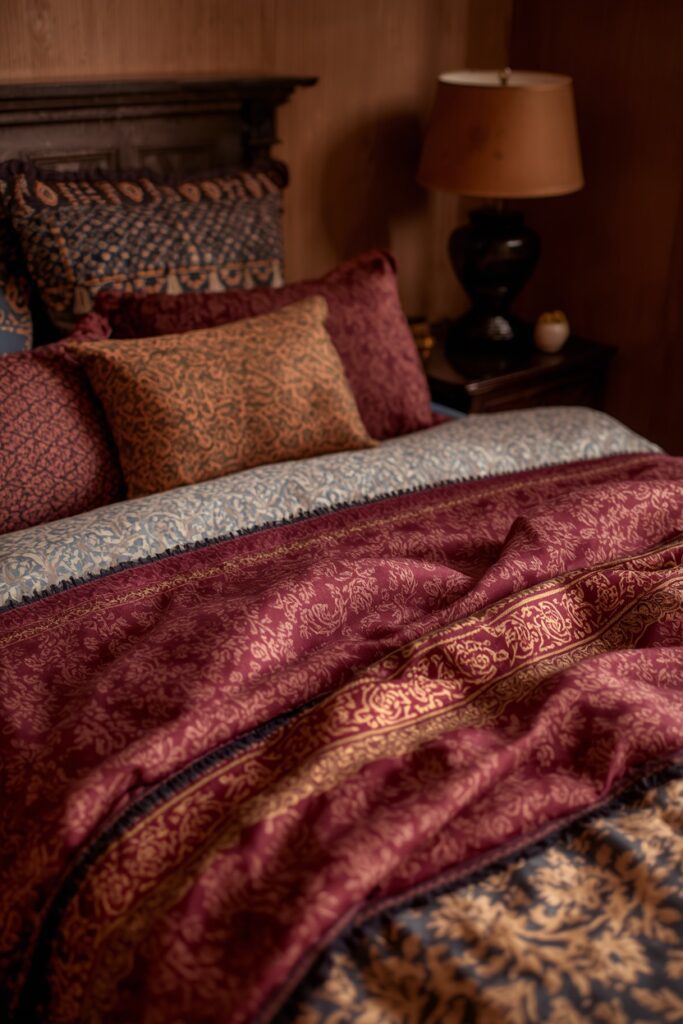
Avoid mixing patterns of identical scale, which creates visual competition rather than richness.
10. A Deep Jewel Colour Palette for Indian Couple Bedroom Decor
The jewel tones of traditional Indian textiles — deep ruby, royal blue, forest green, saffron, magenta, and purple, often with gold — are the defining quality of Indian colour culture and the foundation of these Indian couple bedroom decor ideas. Unlike Western neutral palettes, jewel tones deepen in evening lamplight and glow rather than recede, making a jewel-toned bedroom come most alive at night. Anchor the scheme in one dominant jewel — ruby, sapphire, or emerald — and use gold as the unifying accent through brass objects, embroidery, and trim, keeping the walls warm white or warm greige so the textiles lead.

11. A Kantha Embroidered Throw
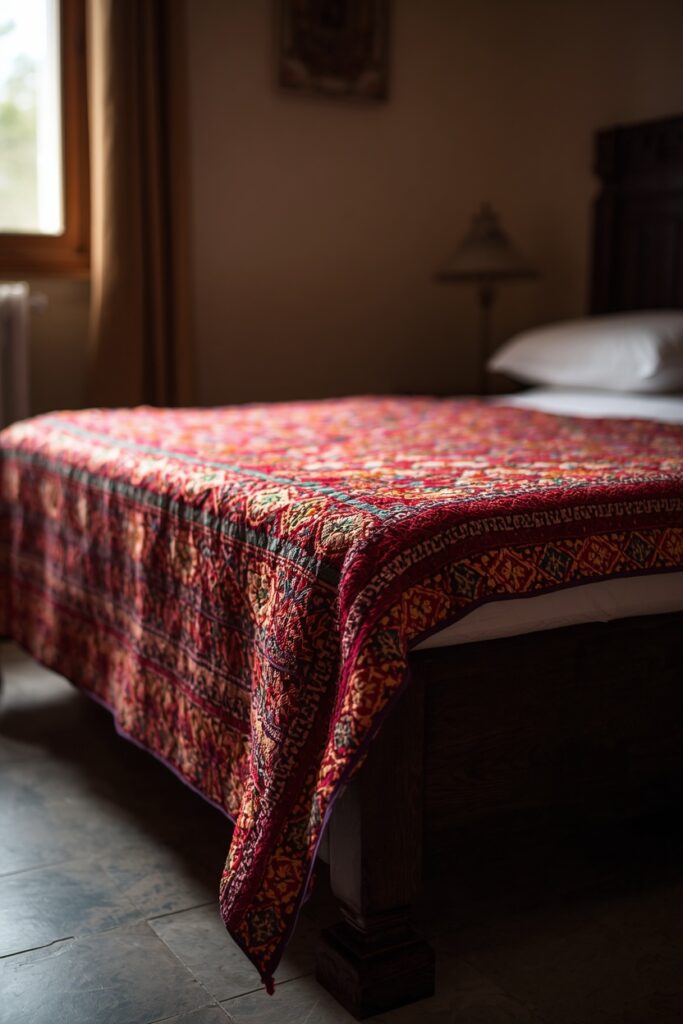
A kantha quilt — made from layers of recycled sari fabric stitched together with the simple running stitch pattern of kantha embroidery — is one of the most authentic and most beautiful pieces of Indian textile craft, each quilt effectively a map of the sari fabric and the hand of whoever stitched it. Kantha throws are lightweight, reversible, and endlessly versatile, working across the foot of the bed, draped over a chair, or hung as a wall piece.
Source them from Bengal or Rajasthan artisan cooperatives where the craft is still practised as a community tradition rather than a factory reproduction.
12. Moroccan-Indian Fusion Lanterns
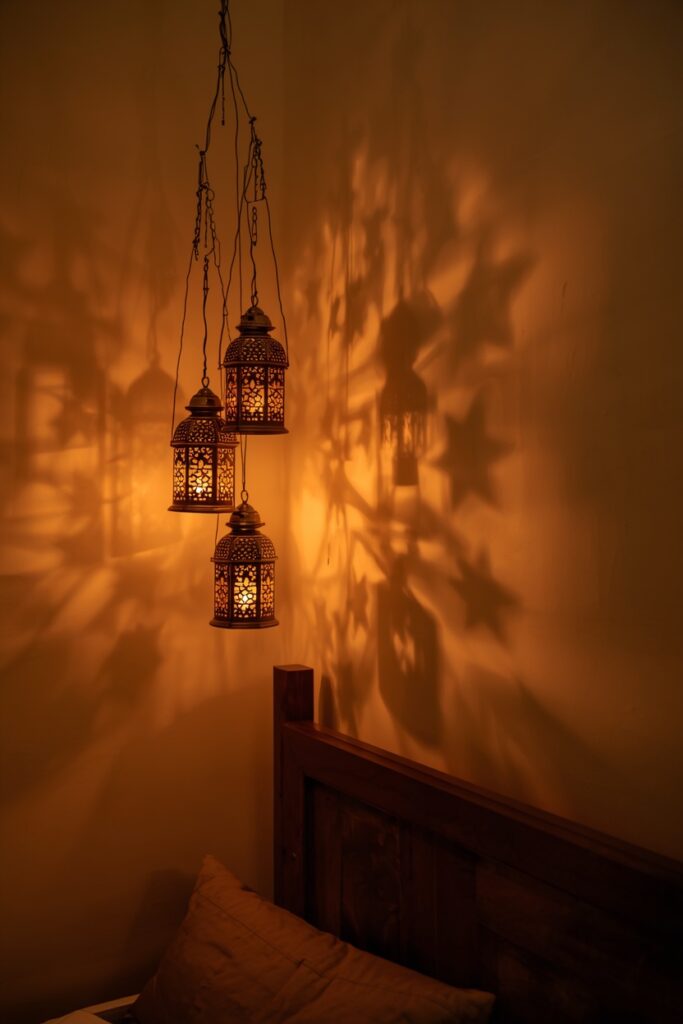
Brass, copper, or iron lanterns with pierced geometric patterns — common to both Mughal Indian and Moroccan decorative traditions — cast beautiful star-pattern shadow projections across the walls and ceiling when lit from inside, turning an ordinary bedroom into a room that glows like a palace at night. Hang one large lantern beside the bed or cluster three lanterns of different sizes and heights in a corner.
Choose warm flame bulbs or LED candle inserts rather than standard bulbs to get the warm, flickering quality that makes the shadow projection most beautiful.
13. Copper and Bronze Decorative Objects
Copper and bronze decorative objects — a water pot (kalash), a small statue, a mirror frame, or decorative bowls — have been central to Indian material culture for millennia and bring a warm, ancient, artisan quality that brass alone cannot fully cover. The reddish warmth of copper and the darker depth of bronze read differently in the same scheme, and mixing the two — a copper vase beside a bronze bowl — is more interesting than using one metal uniformly throughout.
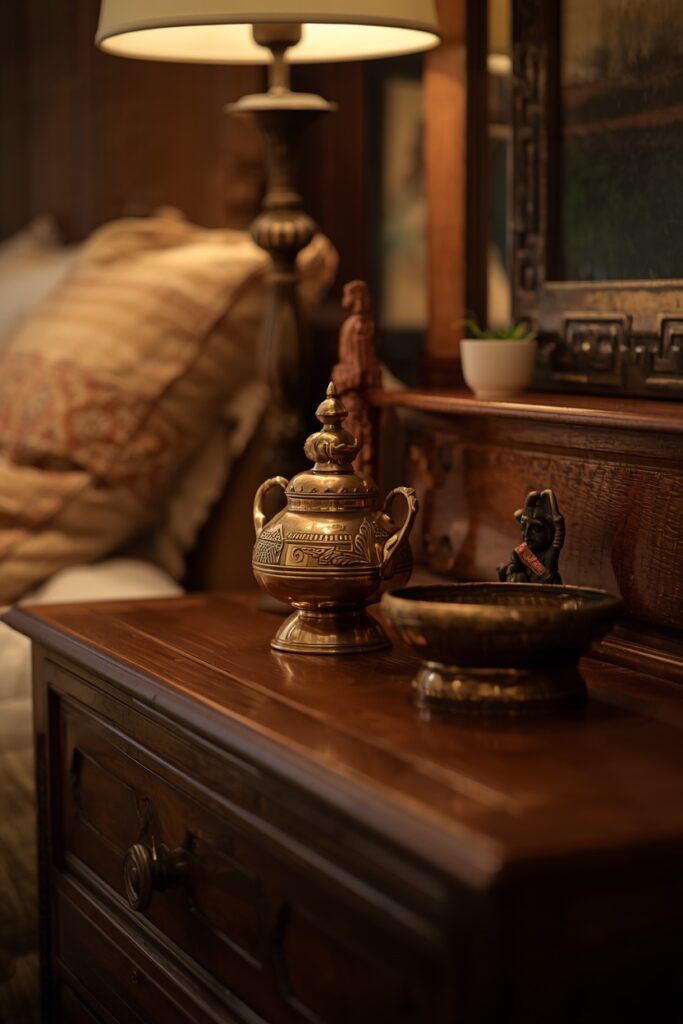
Let copper pieces develop their natural patina rather than polishing them back to bright.
14. A Vintage Meenakari or Miniature Art Piece
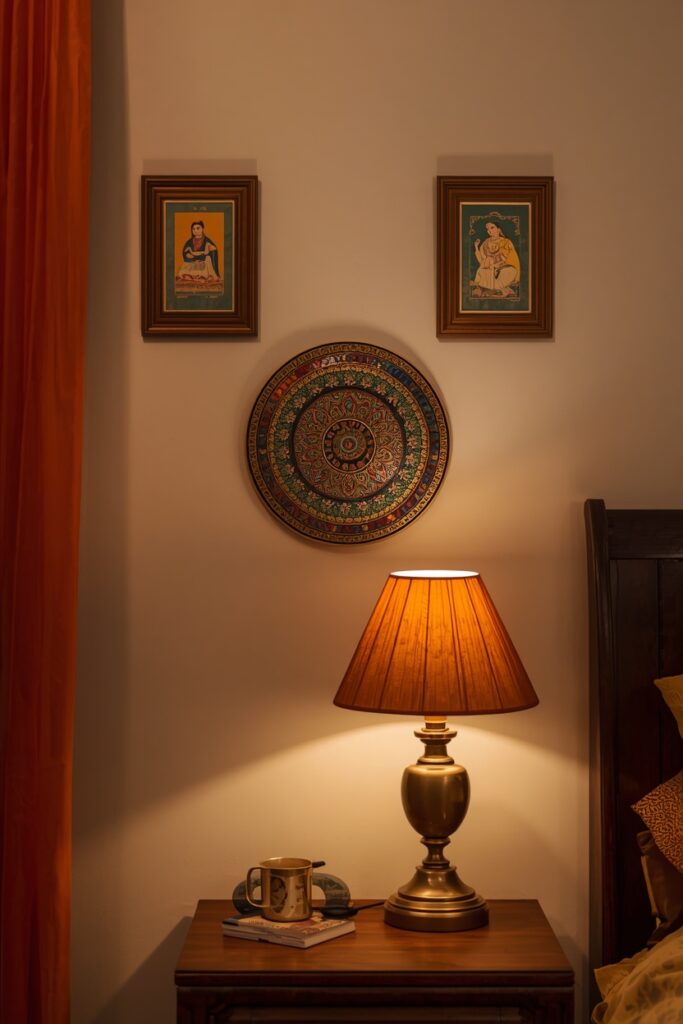
Meenakari — the ancient Indian art of enamel inlay on gold, silver, or copper — produces extraordinarily detailed and colourful decorative pieces: plates, frames, boxes, and panels in which floral and bird motifs are set in vivid enamel against a metallic ground. A single framed meenakari panel or a group of small meenakari objects on a bedside or dresser brings a level of decorative craftsmanship that mass-produced decor simply cannot touch. Indian miniature paintings — small, intensely detailed paintings from Rajput or Mughal tradition — framed and grouped serve the same purpose and are widely available from specialist dealers.
15. Natural Wood and Cane Furniture
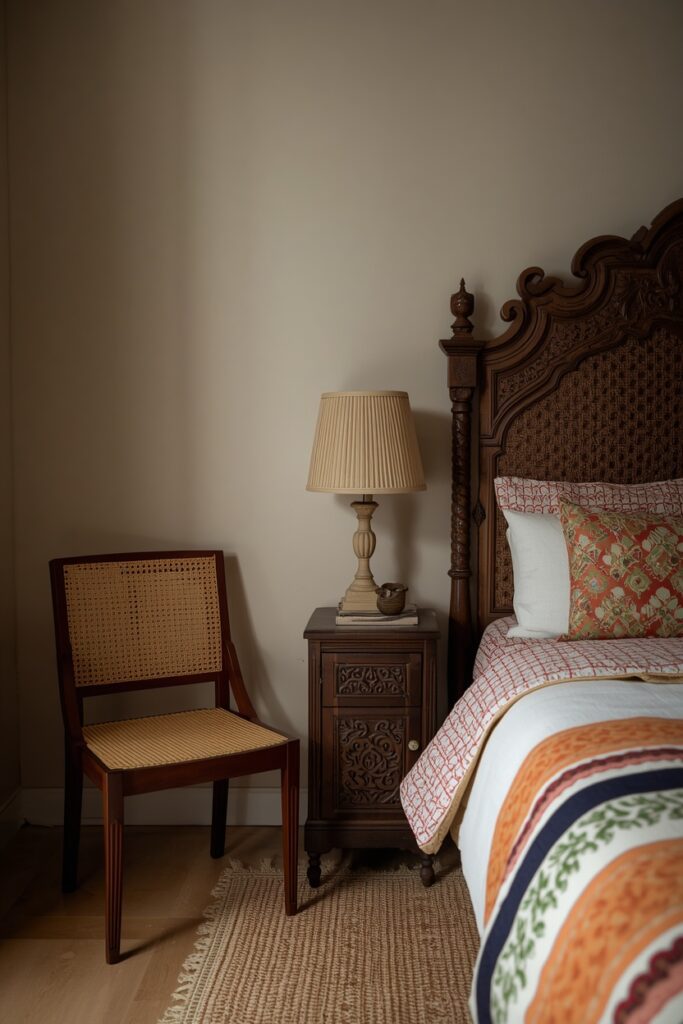
Sheesham, teak, and mango wood furniture — plain or with light carved detail — and cane or rattan accent pieces bring the natural material warmth that grounds the richness of jewel-toned textiles and brass in an Indian bedroom. A carved wood dresser, a cane-seat chair, and a woven rattan bedside work beautifully together.
Choose furniture with genuine joinery and visible grain rather than MDF or veneered pieces: the warmth and weight of solid timber is part of what makes Indian furniture read authentic and substantial rather than decorative.
16. A Gallery Wall of Cultural Prints
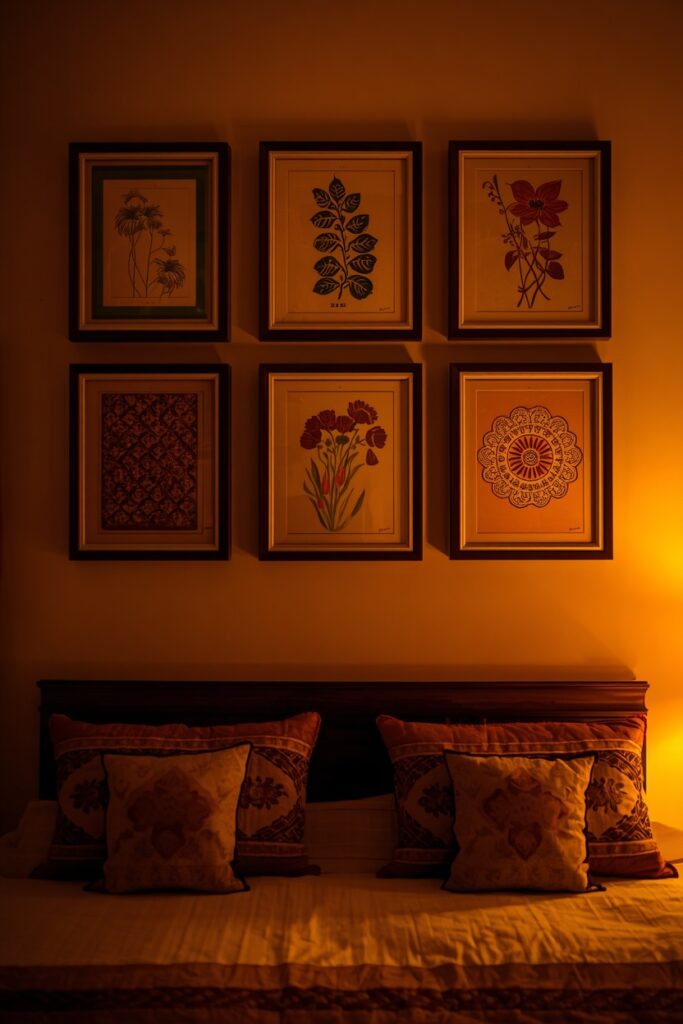
A gallery wall of Indian cultural imagery — botanical prints in the tradition of Company School paintings, Kalighat folk art prints, geometric rangoli patterns, or block-print inspired textiles framed in simple dark frames — turns a plain bedroom wall into a curated celebration of Indian visual culture. Mix print scales and a few frame sizes for visual rhythm rather than identical frames in a uniform grid, since the collected, gathered quality of a slightly varied arrangement reads more personal and authentic than a perfectly matched set.
17. Mirror Work or Embroidery as a Wall Feature
A large panel of mirror work (shisha embroidery) — in which hundreds of tiny convex mirrors are set into fabric with colourful embroidery around them — hung above the bed or on a feature wall transforms the bedroom with both colour and reflected light, every tiny mirror catching and scattering the room’s lamplight. Mirror-work panels in Gujarati or Rajasthani tradition are among the most visually extraordinary textile pieces in Indian craft.
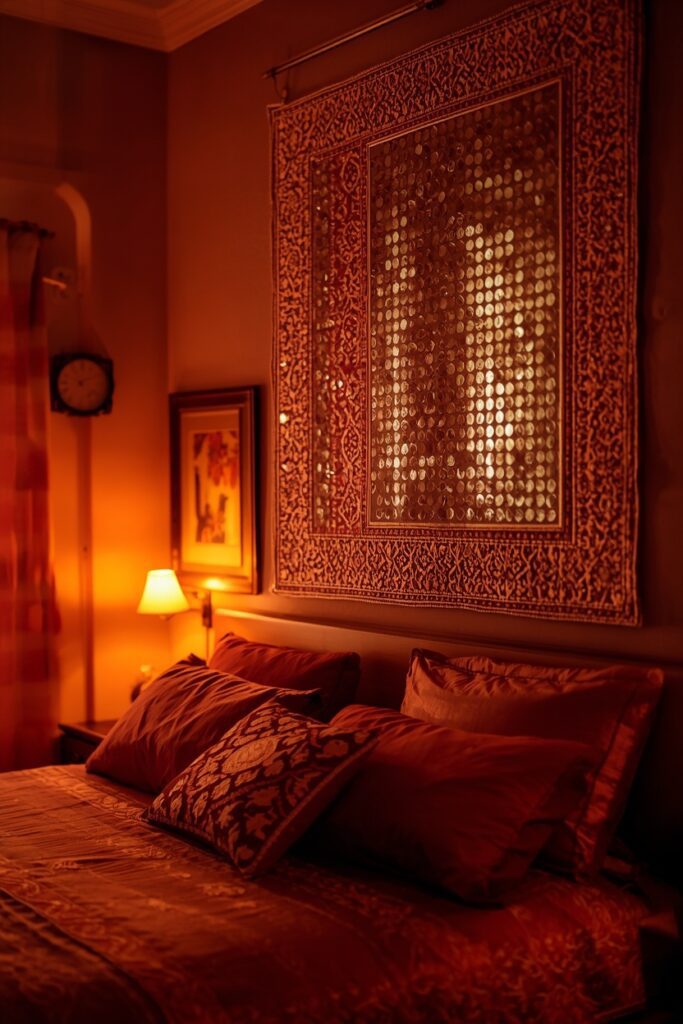
Hang the panel on a single simple rod or directly on the wall with a pair of hooks, and light it from a low, warm angle to maximise the mirror scatter.
18. The Complete Indian Couple Bedroom
Brought together, a complete Indian bedroom layers a carved sheesham headboard, jewel-toned block-print bedding, embroidered silk cushions, a kantha throw, a dhurrie rug, brass and copper objects, a jali screen, meenakari art, and warm lantern lighting within a warm jewel-tone palette — every element genuinely made by hand, by craft traditions with centuries behind them. The richness of an Indian bedroom comes from the authenticity and layering of real craft, not from reproduction prints or plastic gilding. Choose a few pieces of genuine quality, layer them with care, and the bedroom will read as a space of real cultural beauty and personal meaning.

Where I’d Start if I Only Did Three Things
If I only did three things to create an Indian couple bedroom, I’d start with the bedding: genuine hand-block printed fabric in a deep jewel tone immediately sets the cultural tone more powerfully than any other single change. Next, I’d add two or three pieces of real brass — a hammered tray, a pair of lamp bases — because the warm gold of handworked brass is the material most associated with Indian domestic beauty. Third, I’d hang a mandala or a mirror-work panel above the bed so the wall reads as cultural and considered rather than empty. Real block print, genuine brass, and a strong wall piece — those three anchor everything else.
FAQs
What are the best Indian couple bedroom decor ideas?
The best Indian bedroom designs draw on authentic Indian craft traditions: hand-block printed bedding from Jaipur or Rajasthan, a carved sheesham or teak headboard, embroidered silk cushions in zardozi or kantha, hammered brass accents, a dhurrie rug, a jali screen or mandala wall piece, and warm lantern or brass lamp lighting within a jewel-tone palette. The richness comes from genuine handcraft rather than reproduction mass-produced items. Choose a few authentic pieces of real quality over many cheap approximations, layer them within one jewel-tone colour family, and keep the walls warm white so the textiles and objects lead.
What colours work best for an Indian-inspired bedroom?
The traditional Indian colour palette for interiors is built on jewel tones: deep ruby red, royal blue, forest green, saffron, magenta, and rich purple, almost always with warm gold as the unifying accent. These tones come from natural dyes — indigo, madder, turmeric, and lac — that have been used in Indian textiles for millennia. In a modern bedroom, anchor the scheme in one dominant jewel tone and use gold through brass objects, embroidery, and trim. Keep the walls warm white or warm greige so the jewel-toned textiles and brass objects lead the room rather than competing with a coloured wall.
How do I source authentic Indian bedroom decor?
Authentic Indian craft pieces are most reliably sourced through artisan co-operatives, fair-trade retailers, and specialist importers rather than general homewares shops. Look for verified block-print bedding from Jaipur or Bagru, kantha quilts from Bengal artisan groups, dhurrie rugs from Rajasthan, and sheesham furniture from established Indian furniture makers. Online platforms that directly connect artisans to buyers are increasingly accessible. When purchasing brass or copper, look for hand-hammered or hand-engraved pieces rather than machine-pressed ones, since the slight irregularities of hand-work are both aesthetically superior and the mark of genuine craft.
How do I mix Indian decor with a modern bedroom?
The most effective approach is to anchor an otherwise calm, modern room with one or two strong Indian elements rather than filling every surface. A carved wood headboard against plain white walls reads stunning without requiring a full jewel-toned scheme. A single kantha throw over modern linen bedding introduces Indian craft gently. A mandala print above the bed, a brass lamp on a minimalist nightstand, or a dhurrie rug on a pale timber floor all work within a modern context. The key is giving each authentic piece enough clear space to read on its own, since Indian craft objects are strong enough to anchor a room without being crowded by others.
Final Thoughts
An Indian couple bedroom that draws on genuine craft traditions — hand-block printed textiles, carved timber, embroidered silk, hammered brass, kantha quilting, and jali screens — becomes a room of real cultural depth and personal meaning rather than just a decorated space. These ideas give you the authentic elements to build that depth: choose a few pieces of real quality, layer them within a jewel-tone palette, light them with warm brass lamps and lanterns, and keep the walls calm enough for the craft to lead. The result is a bedroom that reads as rich, warm, and completely personal in the best possible way.