
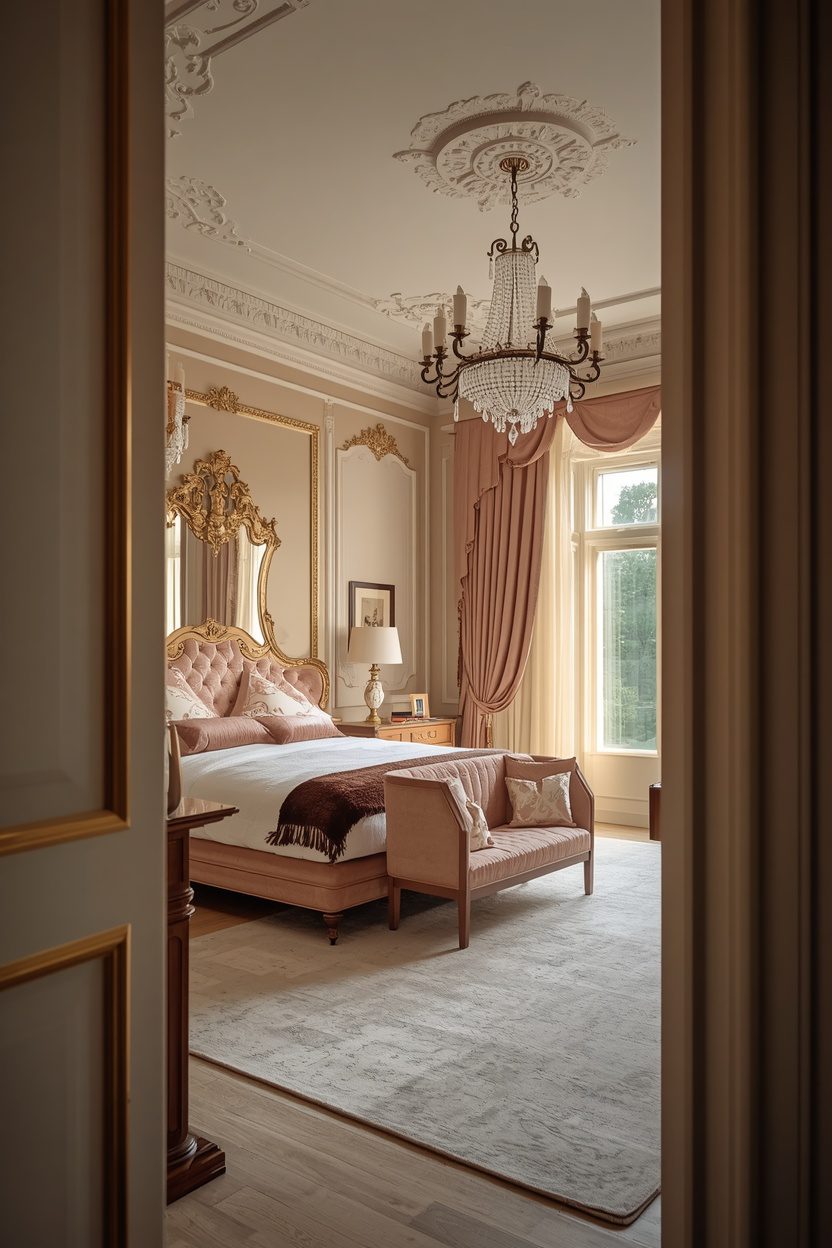
Rococo works in a modern bedroom for one reason most design guides skip: it is not about excess, it is about curves. The style was born as a reaction to the heavy symmetry of Baroque — lighter, more playful, built on flowing lines and asymmetric ornament. That DNA translates into bedrooms that read as soft, collected, and a little theatrical without turning into a period costume set.
These seventeen rococo bedroom interior design trends take the best of that 18th-century vocabulary — gilded frames, cabriole legs, shell motifs, and hand-pleated textiles — and drop them into rooms you can actually sleep in. Every idea here is a complete bedroom concept, not a single accent piece. The goal is a space that looks layered and storied, like it was assembled over years of deliberate collecting rather than ordered from a single catalogue page.
1. Blush and Gold Canopy Bed Suite
A four-poster canopy bed in an antique gold frame with sheer blush curtains draped loosely from the rails sets the entire mood of the room in a single piece. Surround it with pale rose walls and ivory crown molding so the gold reads warm rather than gaudy. Nightstands should have curved cabriole legs in a cream lacquer to carry the Rococo silhouette without competing with the bed.
Layer the bedding in blush linen, ivory sateen, and one dusty-rose velvet bolster for depth. Keep the rug an oversized cream wool with a subtle scrollwork border — it grounds the room without adding another strong color.
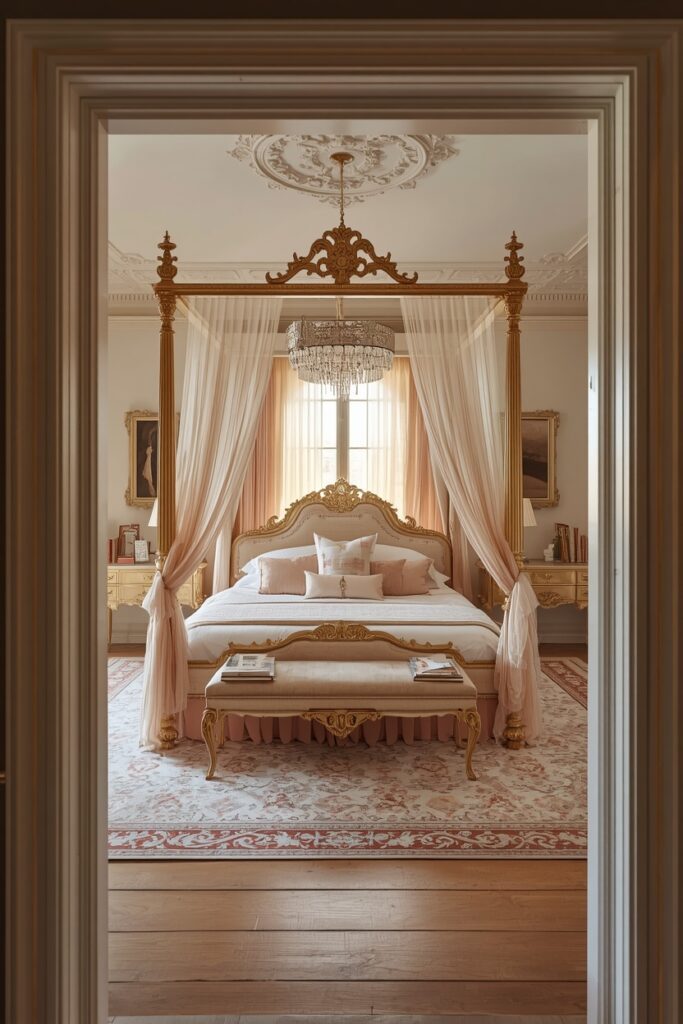
The chandelier above can be a small-scale crystal pendant rather than a massive fixture to keep the scale right for a residential ceiling height.
2. Gilded Mirror Gallery Wall
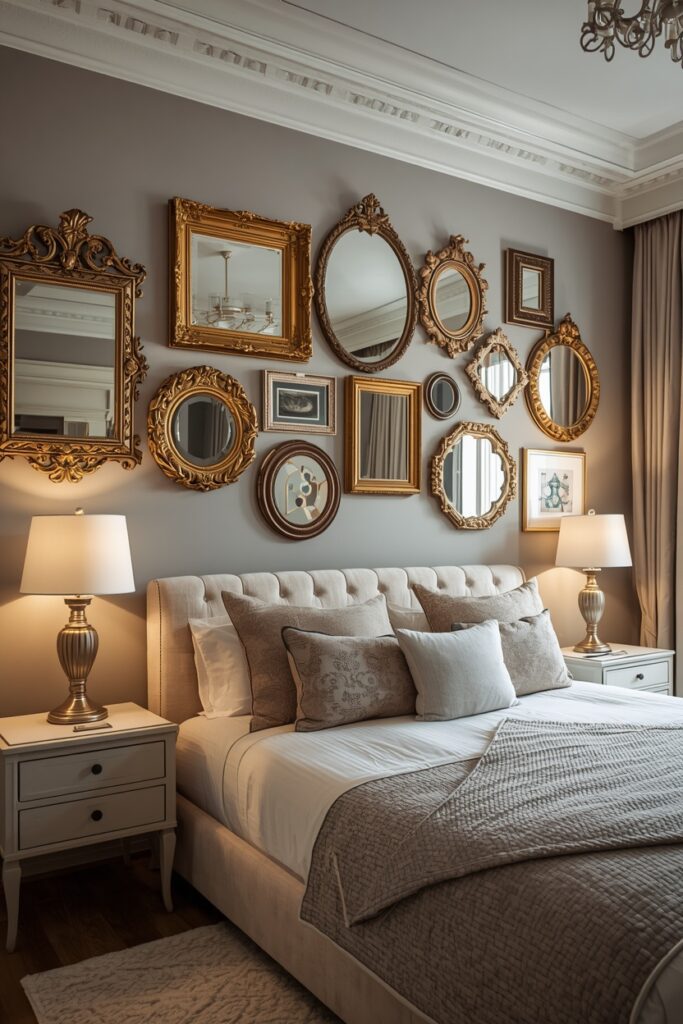
Cluster five to seven ornate gilded mirrors in different sizes and frame styles across one wall to create a gallery that bounces light and adds depth to the entire room. Choose frames with shell, scroll, and floral carvings in mixed gold tones — antique gold, champagne, and warm brass — so the grouping reads collected rather than matched. Arrange them asymmetrically around a central oversized oval mirror for a composition that draws the eye without strict geometry. The facing wall should stay quiet — a solid soft grey or warm white — so the mirror gallery becomes the clear focal point. This approach adds Rococo ornament to the room without requiring ornate furniture, which makes it a strong move for renters or anyone working with a tighter budget. Pair the gallery with a simple upholstered bed in cream or stone linen to keep the balance.
3. Velvet Tufted Headboard in Jewel Tones
A deep-tufted headboard in emerald, sapphire, or amethyst velvet is the fastest way to inject Rococo drama into a bedroom without committing to ornate furniture everywhere. Choose button tufting with a curved or serpentine top edge rather than a flat rectangle — that curved silhouette is what ties it to the period. The headboard should sit against a wall painted in a muted complementary tone: sage behind emerald, dusty blue behind sapphire, warm grey behind amethyst. Keep the rest of the bedding in ivory or champagne so the headboard commands attention without competition.
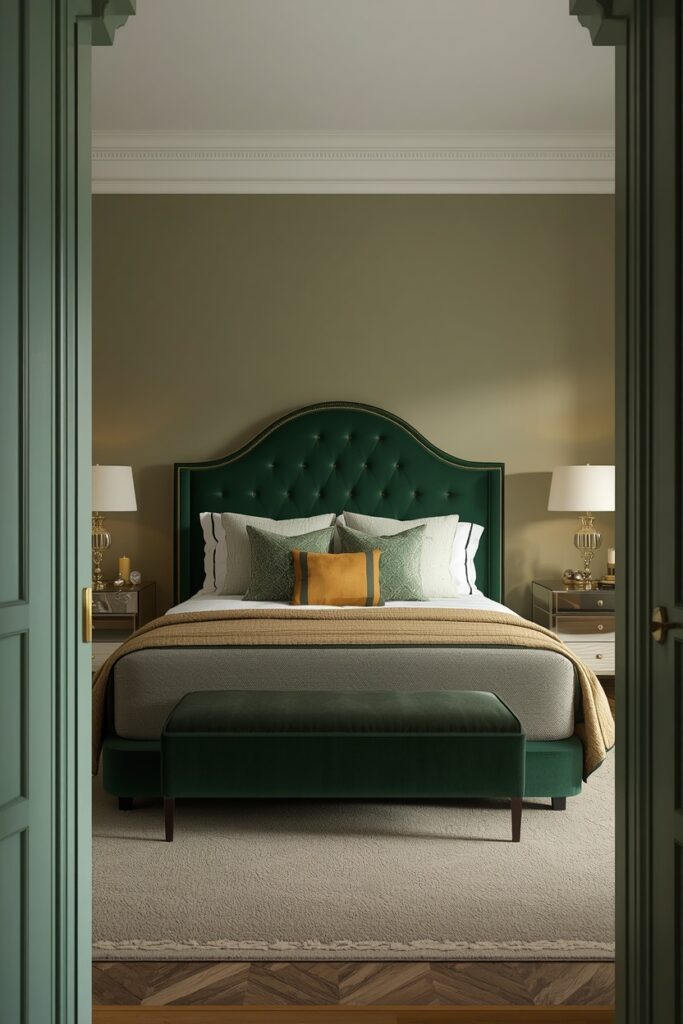
Flanking the bed with slim gold-leafed side tables or mirrored nightstands reinforces the opulent mood without crowding the room. Add a faux-fur throw across the foot of the bed for texture contrast that photographs beautifully and reads as inviting when you walk in.
4. Pastel Rococo Bedroom Interior Design with Modern Storage
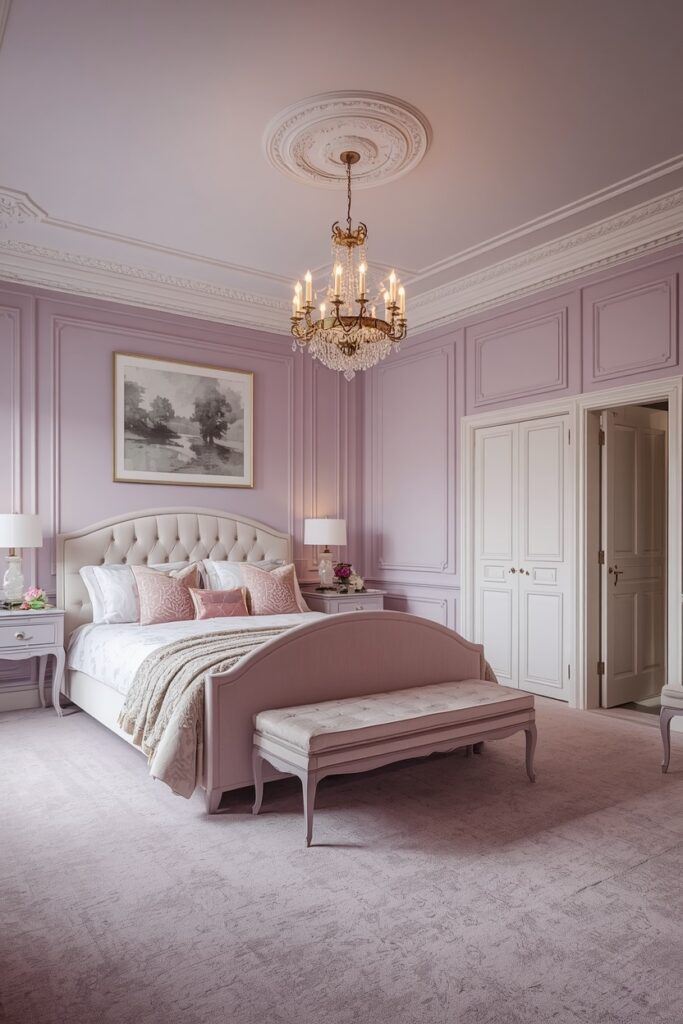
Soft pastels — powder blue, lavender, mint, and blush — were core to original Rococo palettes, and they translate directly into bedrooms that read as airy and romantic without heavy ornament. Paint the walls in a pale lavender and pair with white paneled wainscoting on the lower third for structure. The bed frame should be an upholstered arch in blush or powder blue fabric, sitting low so the pastel wall becomes the backdrop. Here is where modern practicality comes in: use a built-in wardrobe with smooth flat-panel doors painted in the same wall color so storage disappears into the architecture.
Bedside tables with a single drawer in a soft white lacquer keep the Rococo curve in their legs while hiding phone chargers and clutter. Hang a crystal-drop chandelier at a modest scale — 18 to 22 inches wide — for sparkle that stays proportional to the room.
5. Ornate Ceiling Medallion with Statement Lighting
A plaster ceiling medallion in a shell-and-scroll pattern draws the eye upward the moment you walk in, adding architectural drama that most modern bedrooms lack entirely. Choose a medallion 24 to 36 inches across — proportional to the room — and mount a chandelier or oversized pendant through its center. Paint the medallion in the same white or cream as the ceiling so it registers as architecture rather than decoration, or pick it out in a pale gold for a bolder statement.
The rest of the ceiling should stay flat and clean so the medallion acts as a focal frame rather than part of an all-over busy treatment. This pairs particularly well with otherwise simple rooms — a platform bed, clean nightstands, and neutral bedding — because the medallion does the ornamental heavy lifting on its own.
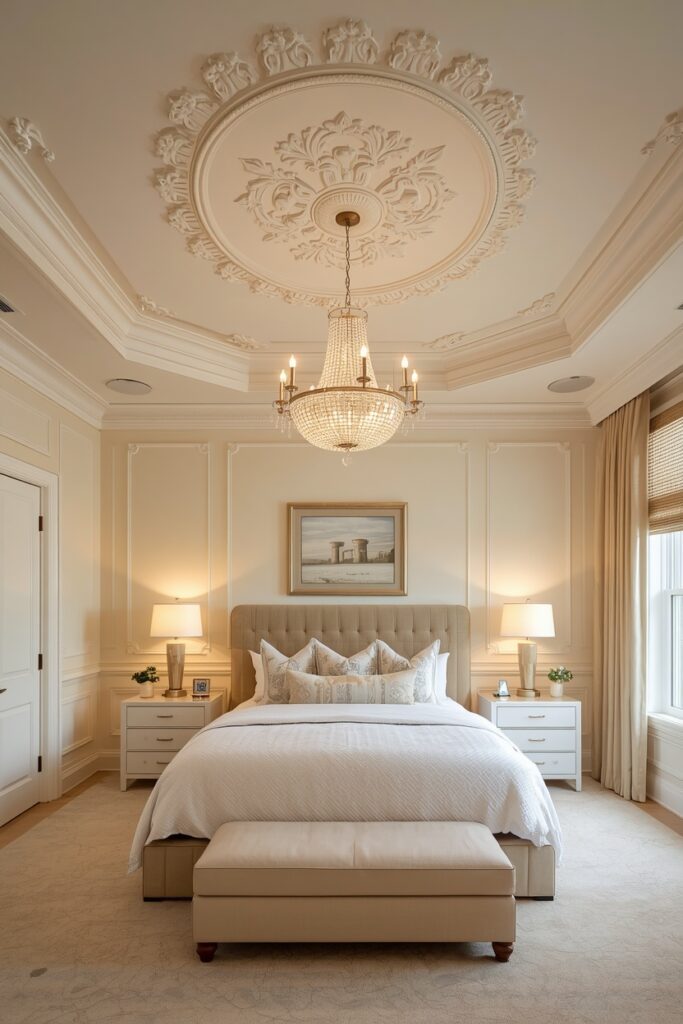
The trade-off is installation: plaster medallions are heavy and need proper ceiling anchoring, so plan for a professional mount.
6. Toile de Jouy Feature Wall
A single wall in classic toile de Jouy wallpaper brings narrative illustration into the bedroom — pastoral scenes, garden motifs, or architectural vignettes in a single ink color on a pale ground. Choose a blue-on-cream or charcoal-on-ivory toile for a crisp look that reads as collected rather than overly sweet. Hang it behind the bed and keep the remaining three walls in the ground color of the toile so the room wraps consistently. The bedding should pull from the toile palette: blue and cream, or grey and ivory, in solid tones without competing patterns.
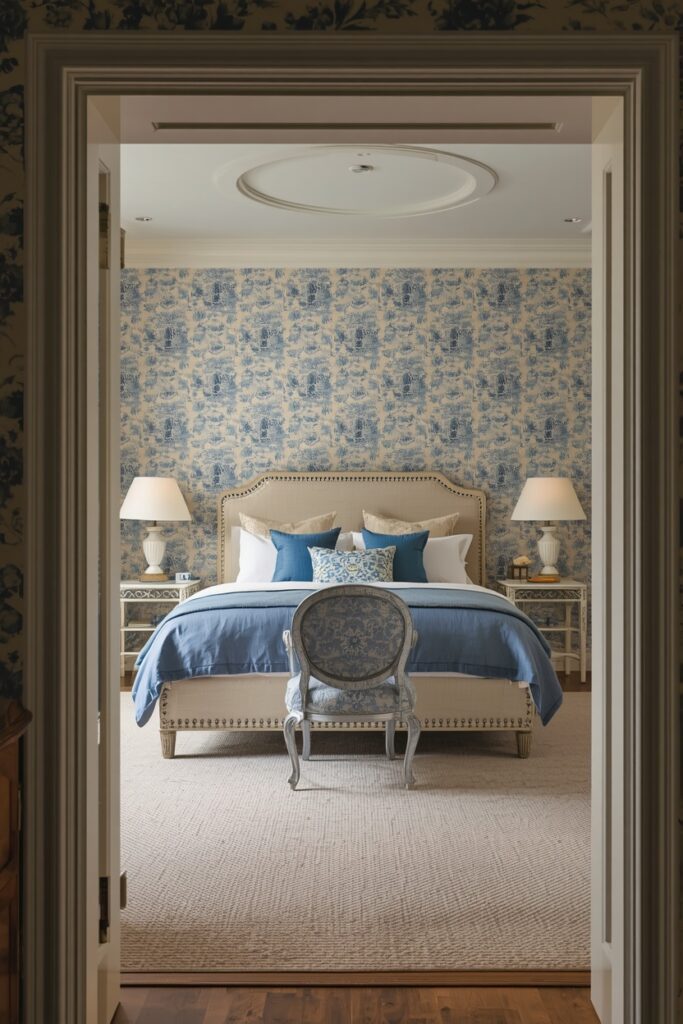
Add one or two accent pieces with Rococo curves — a vanity chair with a scrolled back, a gilded tray on the dresser — to connect the toile to the broader design language. Avoid matching the toile across curtains and pillows at the same time, which tips the room from curated to themed.
7. French Bergère Seating Nook
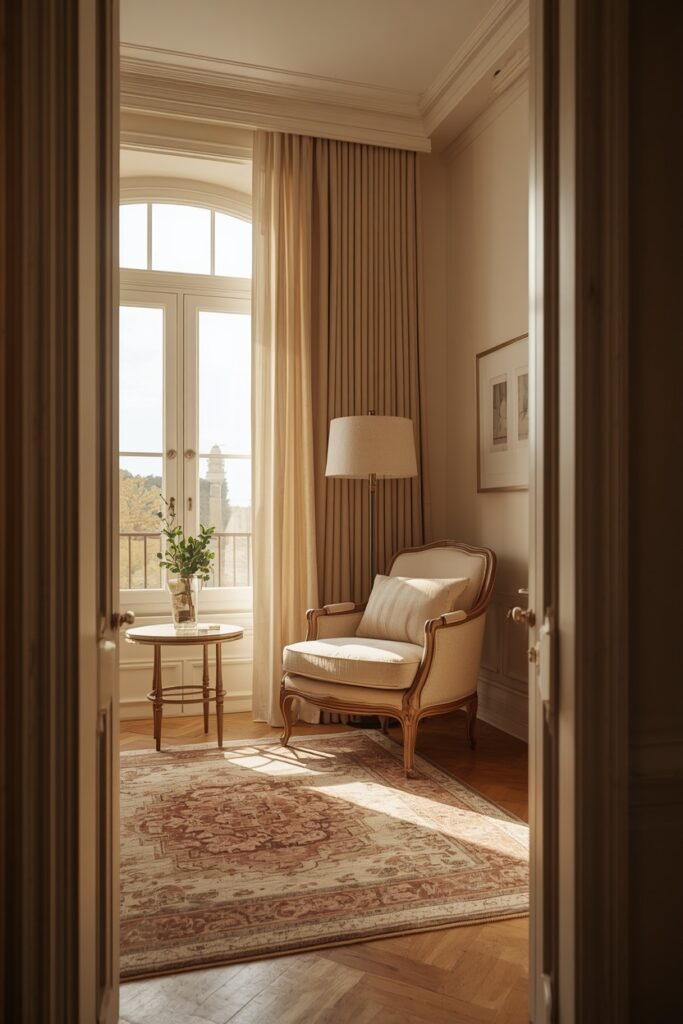
A pair of French bergère armchairs in a corner of the bedroom — angled toward each other with a small round side table between them — creates a sitting area that makes the room read as a suite rather than just a sleeping space. Look for chairs with exposed carved wood frames in a weathered cream or soft gold and upholster them in a muted stripe or solid linen. Position them near a window so natural light makes the nook inviting during the day. Keep the side table simple — a marble-top guéridon or a small gilded pedestal — so the chairs stay the stars. This is a move that adds real function: a place to read, put on shoes, or set down a morning coffee without sitting on the bed. Layer a small vintage rug beneath the chairs to define the nook as its own zone within the larger room.
8. Hand-Pleated Silk Drapery in Soft Neutrals
Floor-to-ceiling hand-pleated silk drapes in champagne, pearl, or soft taupe add a quality of light and movement that no other window treatment matches. Pinch-pleat or goblet-pleat heading styles are the most period-appropriate — skip grommets, which read too contemporary for this context. Hang them from a polished brass or gold rod with decorative finials and let them puddle slightly on the floor for that undone Rococo softness. Line the silk with blackout fabric so the drapes actually function for sleep — unlined silk lets in too much morning light and degrades faster from UV exposure.
The silk catches and diffuses light differently throughout the day, which gives the room a shifting quality that solid curtains never achieve. Keep the wall color behind the drapes a full shade lighter than the fabric so the drapes read as a frame rather than blending into the background.
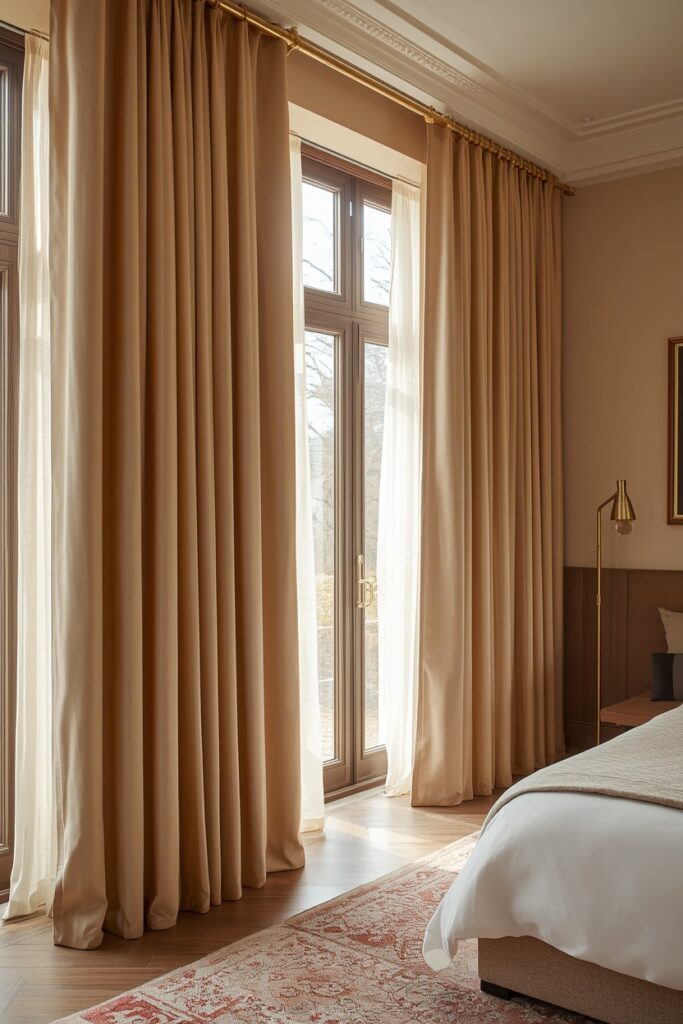
9. Curved Furniture Silhouettes Throughout
Replacing every sharp-edged piece in the bedroom with curved alternatives transforms the entire spatial experience without adding a single ornate detail. A bed frame with a rounded headboard and footboard, nightstands with bowed fronts, a dresser with serpentine drawer faces, and a vanity with cabriole legs — together they create a Rococo rhythm through shape alone. The curves soften the room acoustically and visually, making it read as welcoming rather than rigid.
Stick to a restrained palette — warm whites, soft greys, and one accent like dusty rose or muted gold — so the curves do the talking without color competition. This approach is especially effective in modern builds with clean walls and simple trim because the furniture provides all the character the architecture lacks.
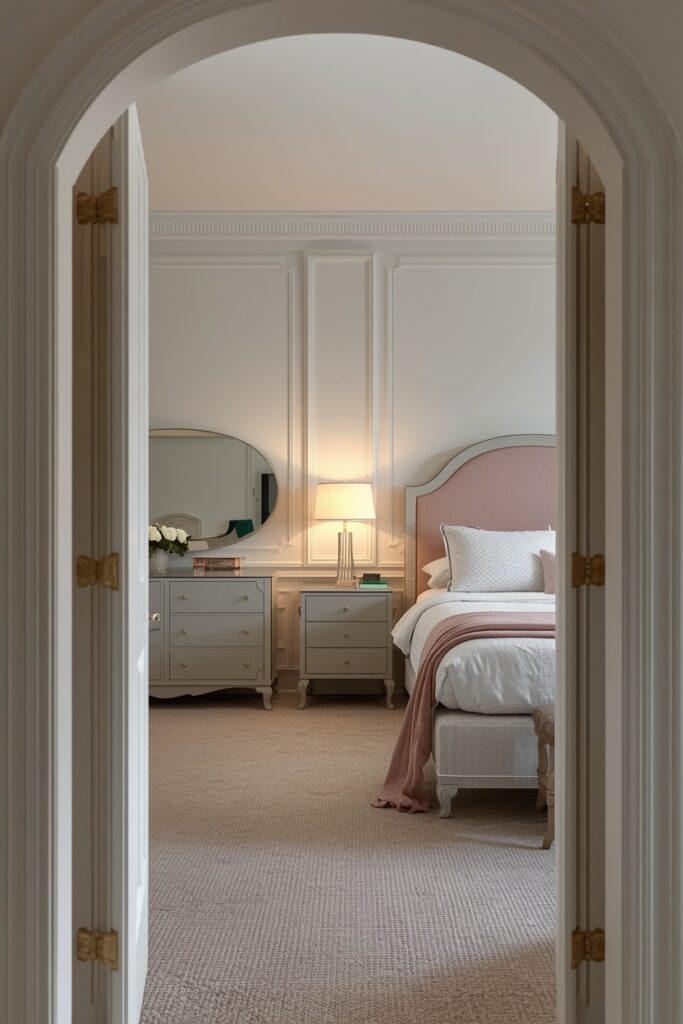
Watch proportions carefully: curved pieces often have wider footprints than straight-edged ones, so measure before committing.
10. Antiqued Gold Leaf Accent Wall for Rococo Bedroom Interior Design
A single accent wall treated with antiqued gold leaf — applied in irregular patches over a matte clay base — brings the richest version of Rococo warmth into the room without wallpaper or paint. The imperfect application is key: a fully gilded wall reads as a nightclub, but a patchy, aged-looking gold over terracotta or deep cream reads as something discovered in a Florentine palazzo. Apply the leaf with a matte sealer so it does not glare under direct light. Position this wall behind the bed so it becomes the backdrop you see from the doorway. Furniture against a gold-leaf wall should stay low-contrast: a cream or oatmeal upholstered bed, linen bedding, and warm wood nightstands. Skip gilded frames on this wall — the leaf itself is ornament enough, and adding more gold tips the room toward costume.
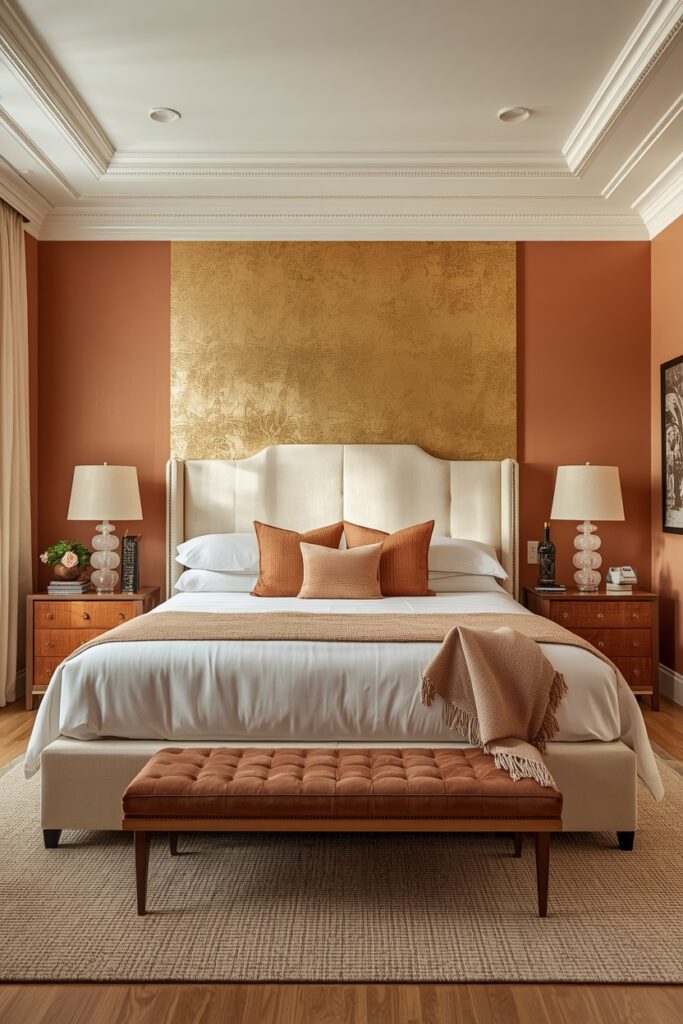
11. Crystal and Brass Layered Lighting
Layering three types of lighting — a crystal chandelier overhead, brass sconces flanking the bed, and a pair of crystal-base table lamps on the nightstands — gives a Rococo bedroom the kind of warm dimensional glow that a single ceiling fixture can never deliver. Choose a chandelier with a brass frame and crystal droplets rather than all-crystal, which can read too formal for a bedroom. Wall sconces should have a curved arm and a fabric shade in cream or champagne to soften the light and echo period forms. The table lamps add task light for reading while reinforcing the crystal motif at a lower level.
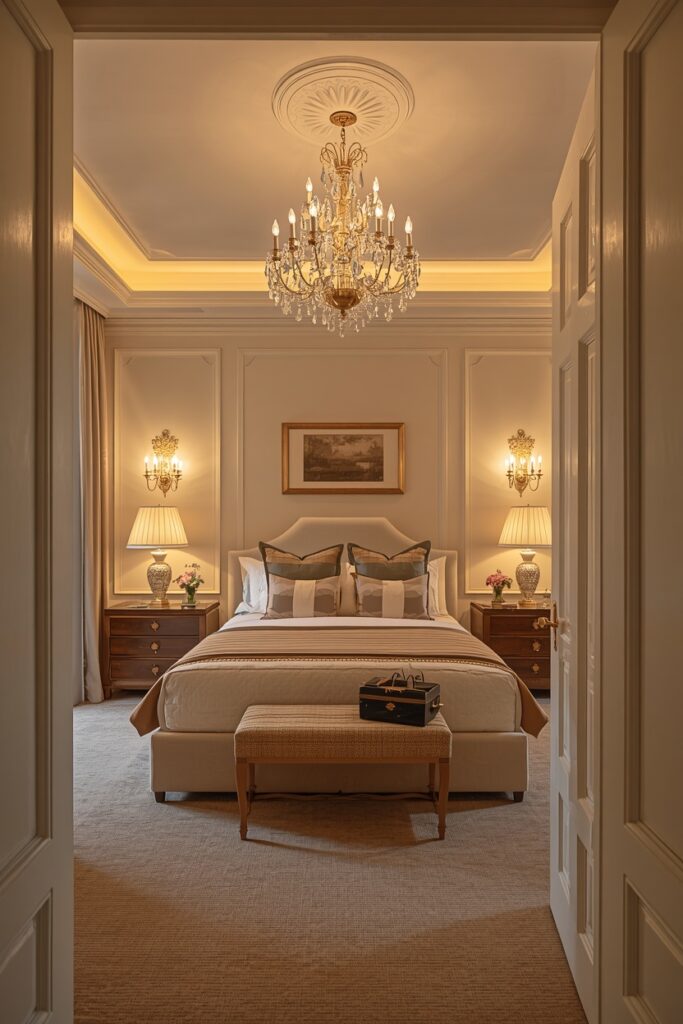
Wire everything through a dimmer so the room shifts from bright and functional during the day to low and atmospheric at night. This three-tier approach also reduces the need for recessed downlights, which puncture the ceiling and undermine the period aesthetic.
12. Shell Motif Textiles and Carved Details
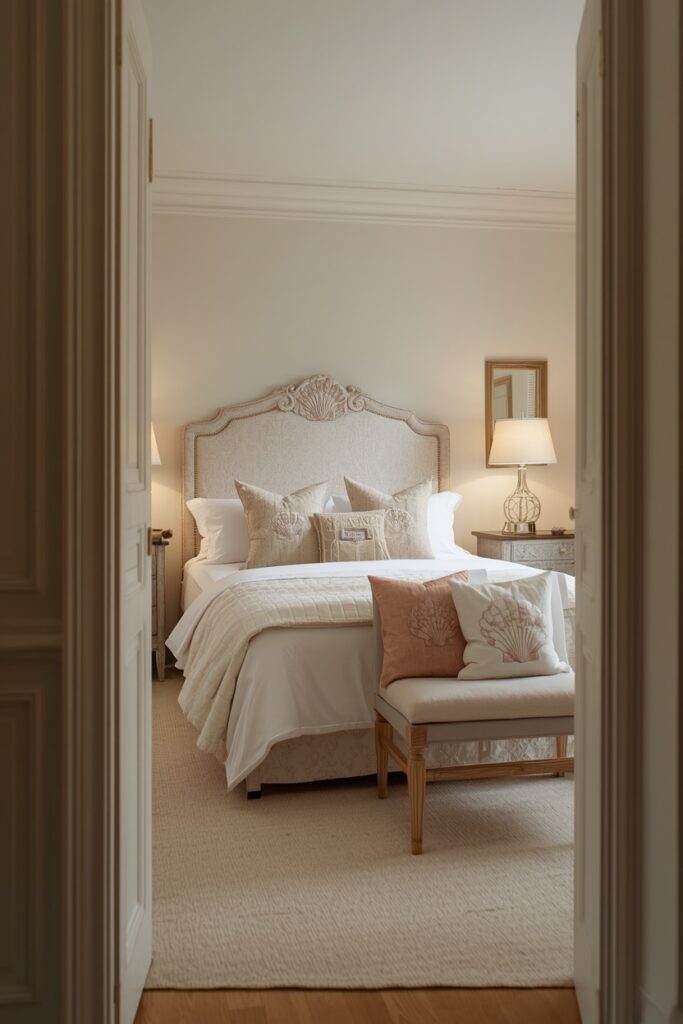
The coquille — or shell — was the defining motif of Rococo decorative art, and weaving it into a bedroom through textiles and carved accents connects the room directly to the style’s origins without overwhelming the space. Look for throw pillows with embroidered or woven shell patterns in tone-on-tone cream or soft gold. A carved shell crest on the headboard or on the frame of a dresser mirror adds three-dimensional ornament that catches light and shadow. Use the motif selectively — two or three placements across the room, not on every surface — so it reads as a recurring theme rather than a repetitive stamp.
Pair shell details with organic textures like raw linen, nubby wool, and woven rattan to keep the room grounded and livable. The beauty of this approach is that it can layer on top of almost any neutral bedroom without requiring a full furniture overhaul.
13. Floor-Length Upholstered Wall Panels
Upholstered wall panels running from floor to ceiling behind the bed create a Rococo-inspired softness that wallpaper and paint cannot match. Use a padded linen or low-pile velvet in a muted tone — dove grey, powder blue, or soft blush — and stretch it over custom frames that mount flush to the wall. The padding absorbs sound, which is a practical bonus in bedrooms that share walls with living spaces.
Divide the wall into three or five vertical panels with thin brass or cream-painted trim between them for a structured look that references period boiserie without replicating it directly. Keep the bed simple when the wall behind it carries this much texture — a low platform frame or a minimal metal frame is a strong pairing.
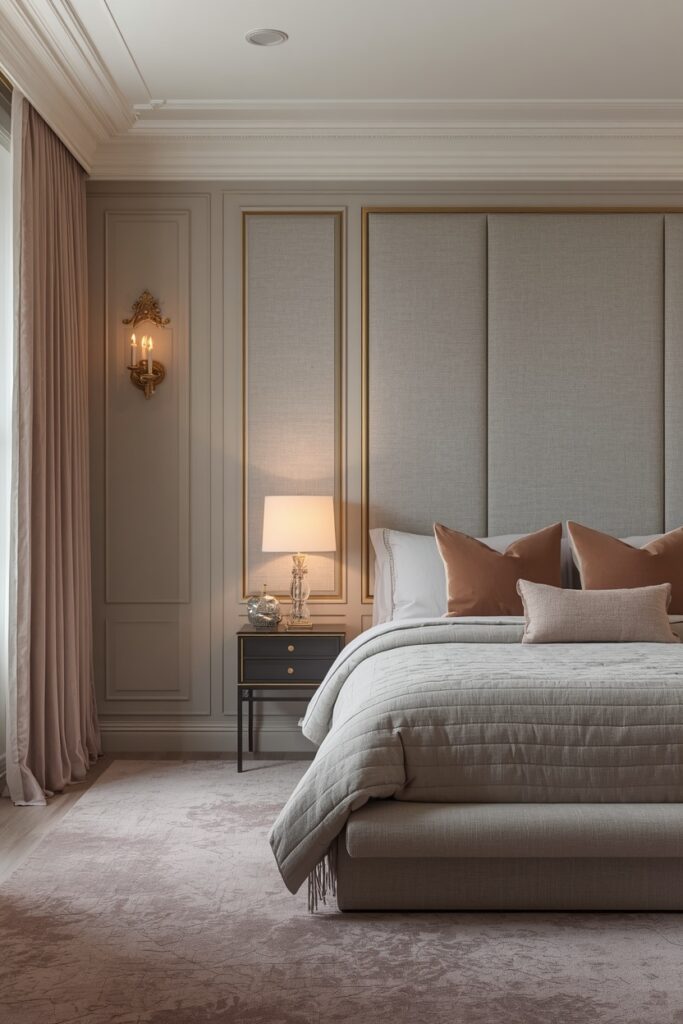
Add a single ornate mirror or a pair of sconces on the padded panels for a layered look that draws the eye to the center of the wall.
14. Marble-Top Vanity with Ornate Stool
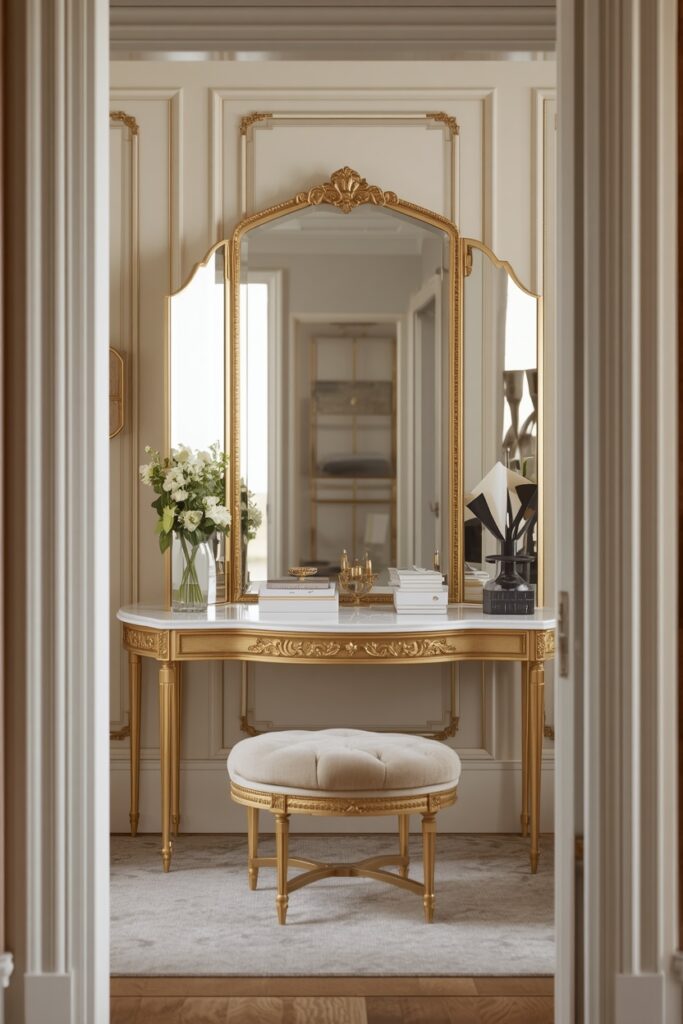
A dedicated vanity station with a marble top, a tri-fold mirror in a gilded frame, and a small upholstered stool with curved legs turns a bedroom corner into a Rococo dressing area that serves real daily function. Choose a vanity table with at least one drawer for daily essentials and a marble top in white Carrara or warm Calacatta to add weight and permanence. The stool should have an open back with a scrolled or shield-shaped frame, upholstered in velvet or a textured brocade that ties to the room’s palette. Position the vanity near a window for the best natural grooming light, and supplement with a pair of small sconces mounted on the mirror frame itself. This setup reads as deliberately curated — it signals that the bedroom is a full living space, not just a place to collapse at night. Keep the vanity surface edited to three or four items — a tray, a vase, a candle — because clutter undercuts the composed aesthetic fast.
15. Muted Rococo Bedroom Interior Design in Earth Tones
Rococo does not have to mean pastels. An earth-toned interpretation — warm clay, deep olive, aged bronze, and raw umber — delivers the same ornamental richness with a grounded, contemporary mood. Upholster the bed in a deep olive velvet with a curved frame and dress it in linen bedding in cream and clay tones. Nightstands in a warm walnut with aged bronze hardware carry the period curve without reading as precious. Paint the walls in a soft raw umber or warm clay and add one ornate mirror in an aged bronze frame as the single Rococo punctuation mark.
Paint Picks: Benjamin Moore Alexandria Beige (HC-77), Sherwin-Williams Roycroft Suede (SW 2842), Behr Olivine (PPU10-17), Benjamin Moore Kingsport Gray (HC-86).
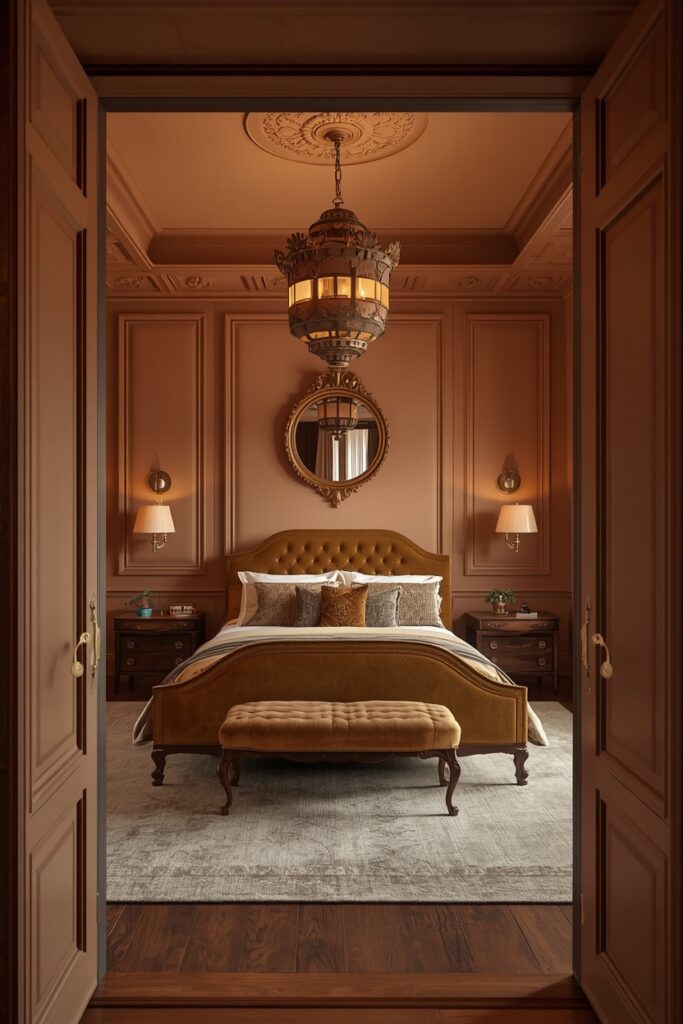
This palette draws from the natural pigments that Rococo artisans actually used before pastel trends took over, so it has historical grounding as well as visual warmth. The key caveat: dark earth tones absorb light, so this scheme needs strong layered lighting — a chandelier, sconces, and table lamps — to avoid reading as heavy.
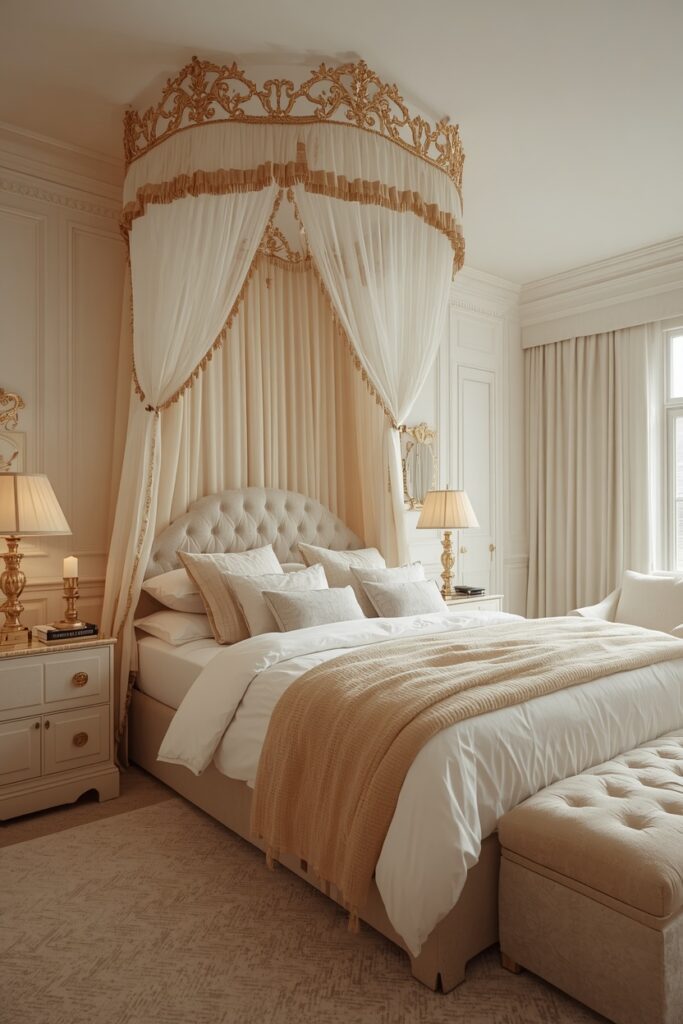
16. Rococo-Inspired Bed Crown with Cascading Fabric
A decorative bed crown mounted to the ceiling above the headboard with fabric panels cascading down either side of the bed creates a canopy effect without the bulk of a four-poster frame. Choose a carved or gilded corona in a half-moon shape and drape sheer fabric — organza, voile, or lightweight silk — from its edges to pool gently beside the nightstands. This is a high-impact addition that can go up without any furniture replacement, which makes it ideal for updating a room on a modest budget. Keep the fabric in a tone-on-tone match with the walls — white on white, cream on cream — so the crown adds shape and romance without adding visual weight.
The hardware needs to anchor into a ceiling joist or use a toggle bolt rated for the weight of the fabric and crown combined, especially with heavier carved wood coronas. Style the bed with simple layered bedding below the crown so the draped fabric stays the focal point.
17. Mixed-Era Rococo and Mid-Century Fusion
Pairing Rococo ornament with mid-century modern furniture creates a tension that makes both styles more interesting than either would be alone. Set an ornate gilded mirror above a clean-lined walnut credenza. Place a tufted velvet bergère next to a slim Scandinavian side table.
Use a crystal chandelier over a low platform bed with tapered legs. The trick is keeping the split roughly even — too much Rococo and the modern pieces look like afterthoughts, too much mid-century and the gilded accents read random. Limit the palette to three tones: one warm neutral, one accent color, and gold as the metallic thread that ties everything together.
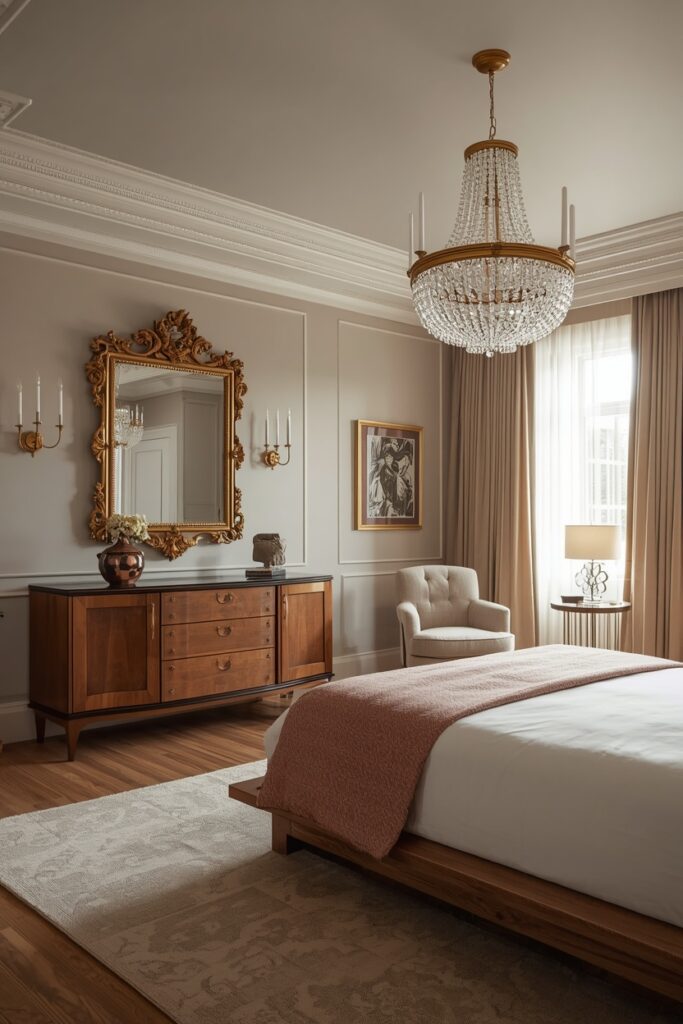
This fusion approach gives the room a collected-over-time quality that neither style delivers on its own, and it works especially well in spaces with clean architectural bones that need personality added through furnishings rather than molding.
Where I’d Start if I Only Did Three Things
If I only did three things, I’d start with a deep-tufted velvet headboard in a jewel tone with a curved serpentine edge — it delivers more Rococo character per dollar than any other single piece. Second, I’d hang one oversized ornate gilded mirror on the wall opposite the bed so it catches light and gives the room architectural weight without structural changes. Third, I’d layer the lighting with a small crystal chandelier overhead and a pair of brass sconces flanking the headboard, because Rococo comes alive in warm, layered light and falls flat under a single ceiling fixture.
Frequently Asked Questions
What defines rococo bedroom interior design compared to baroque?
Rococo grew out of Baroque but moved in a lighter, more playful direction. Where Baroque favors heavy symmetry, dark wood, and large-scale grandeur, Rococo uses asymmetric curves, pastel or pale palettes, gilded accents, and motifs drawn from nature — shells, scrolls, flowers, and vines. In a bedroom context, Rococo furniture has slimmer proportions and more ornamental detail on smaller surfaces, while Baroque pieces tend to be larger and more imposing. The practical takeaway is that Rococo scales down to residential rooms more easily because it was always designed for intimate spaces rather than cathedrals and palaces.
How do I add Rococo style to a bedroom on a budget?
Three affordable moves make the biggest difference. First, swap a plain rectangular headboard for a tufted velvet one with a curved or arched shape — you can find upholstered options under $400 that read as genuinely ornate. Second, add two or three gilded mirrors from thrift stores or vintage markets; mismatched frames look more authentic than matched sets. Third, replace basic overhead lighting with a small crystal or brass chandelier — entry-level options start around $80 and immediately shift the room’s character.
Can Rococo bedroom design work in a small room?
It can, but you need to edit ruthlessly. Choose one or two Rococo statement pieces — a tufted headboard and an ornate mirror, for example — and keep everything else simple and low-profile. Light pastels and pale metallics expand the space visually, so avoid heavy dark fabrics or oversized carved furniture. A bed crown with sheer drapery adds drama without taking floor space, and a single crystal pendant replaces a bulky chandelier while still delivering sparkle.
What colors pair best with a Rococo-inspired bedroom?
The most versatile Rococo palettes start with a soft neutral base — cream, ivory, pale grey, or warm white — and layer in one or two accent tones. Historically accurate options include powder blue, blush pink, mint green, lavender, and champagne gold. For a more contemporary take, muted earth tones like olive, clay, and aged bronze deliver the same ornamental warmth with a grounded, modern mood. Avoid saturated primary colors, which fight the delicate ornamentation rather than supporting it.
Final Thoughts
Rococo bedroom interior design is not about recreating a museum room — it is about borrowing a vocabulary of curves, gilding, and softness and speaking it in a way that suits how you actually live. The best Rococo-inspired spaces pick two or three strong moves and let the rest of the room breathe around them. Whether you go full canopy and chandelier or simply swap in a curved headboard and an ornate mirror, the style rewards restraint as much as it rewards ornament. Start with the pieces that make you pause in the doorway, and build outward from there.
Leave a Reply