
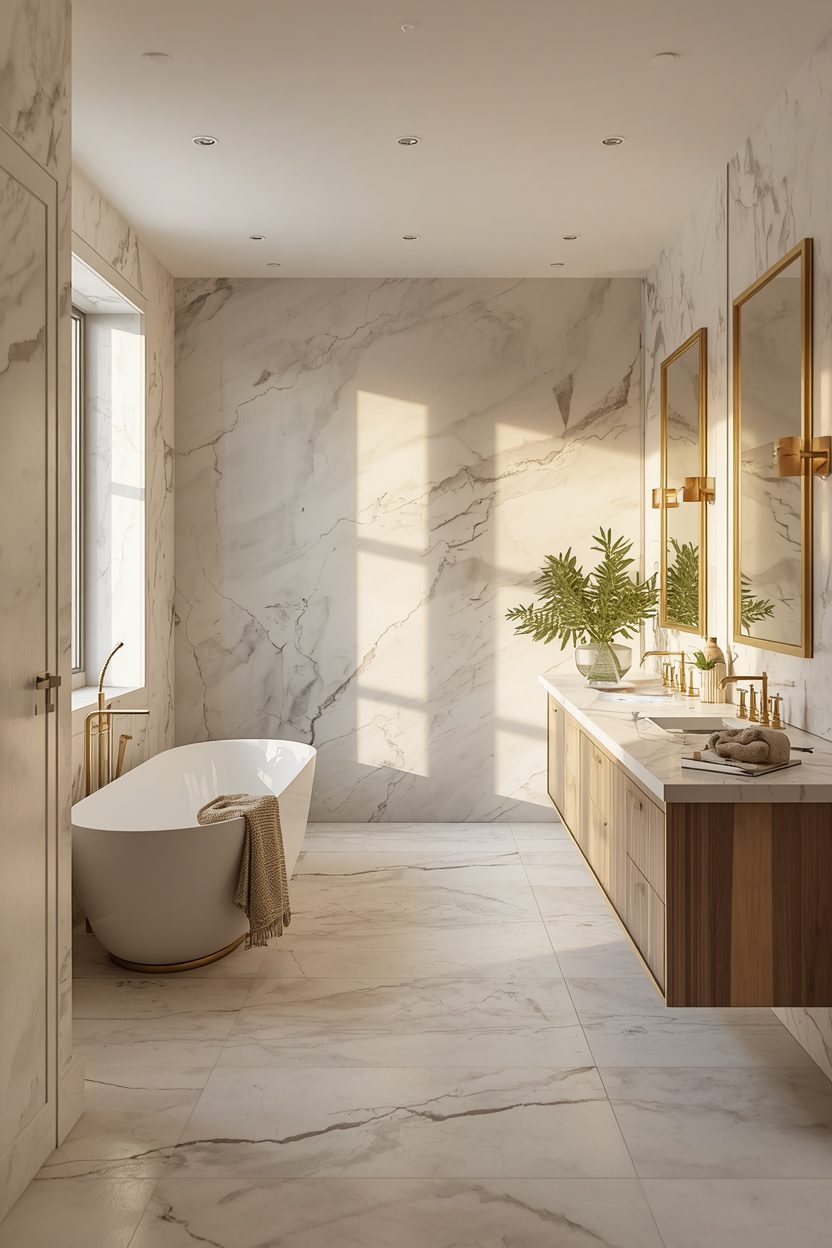
The most common mistake I see with a luxury marble bathroom is treating marble like wallpaper — running it over every surface until the room reads like a showroom rather than a retreat. Great marble ensuites are edited: one hero stone, one feature moment, and a tightly held palette that lets the veining breathe. Get that restraint right and even a modest amount of stone reads expensive.
This guide walks through 14 complete master ensuite designs, each built around a specific marble — Calacatta, Carrara, Emperador, Nero Marquina, onyx and more — with the palette, the layout and the honest upkeep notes for each. Whether you are planning a full renovation or a single statement wall, there is a version here to match your budget and your patience for maintenance.
1. Calacatta Gold Statement Wet Room
A Calacatta Gold wet room turns the whole ensuite into a single sweep of stone, with book-matched slabs running from the shower across to the vanity wall. Pair the bright white ground and dramatic gold veining with warm brass fittings and a low-profile linear drain so nothing competes with the marble. Keep the palette to three tones — white stone, gold vein, brushed brass — and let the veining be the only pattern in the room. Budget realistically: full-height Calacatta is among the priciest natural stones, and you want a fabricator who can dry-lay the slabs to book-match the veins before install. Underfloor heating earns its place here, because large marble floors read cold underfoot and the warmth also helps the wet room dry faster.
2. Warm Emperador Brown Spa Ensuite
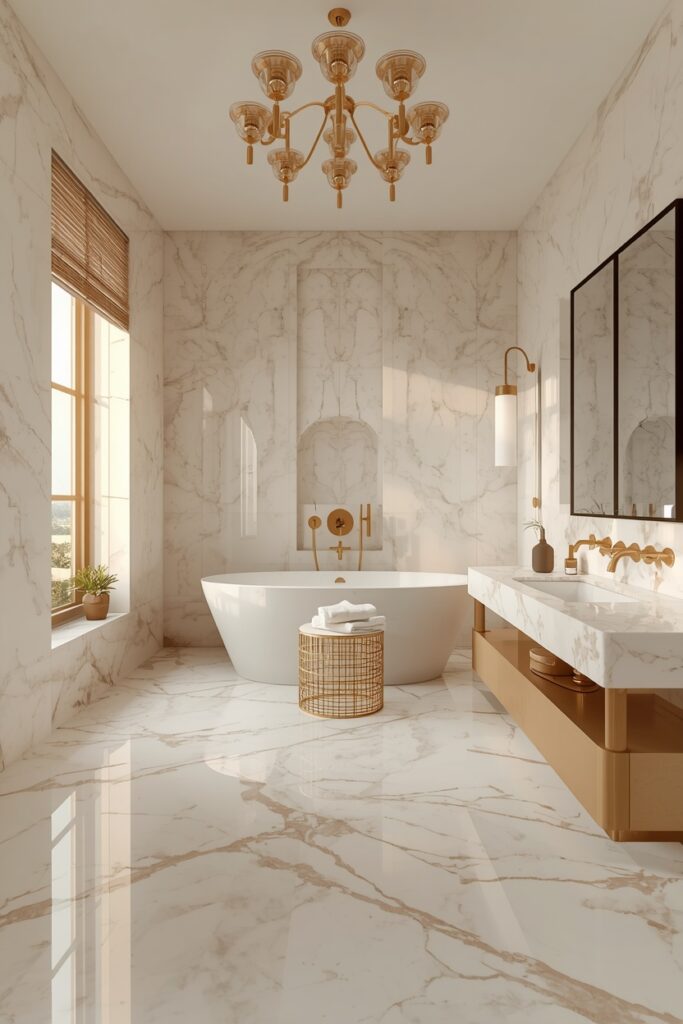
Swap the usual cool gray for Emperador brown marble and the entire ensuite reads like a warm spa rather than a showroom. Run the deep chocolate-and-caramel stone across the floor and a single feature wall, then balance it with cream plaster walls and unlacquered brass so the room does not tip too dark. A honey-toned oak vanity keeps the mood grounded, and a freestanding stone basin anchors the layout.
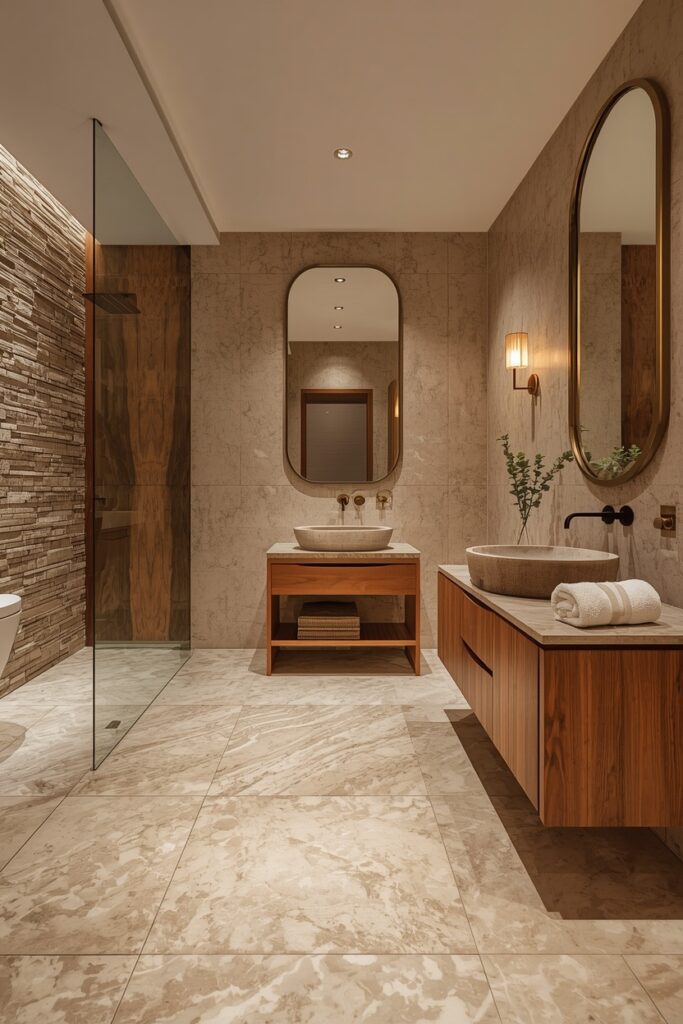
The trade-off with dark marble is maintenance: etch marks and water spots show faster on polished brown stone, so I specify a honed surface and a penetrating sealer reapplied yearly. If your ensuite has one small window, this palette can swallow light, so layer in warm wall sconces at eye level to keep it from going gloomy.
3. All-White Carrara Marble Master Bathroom
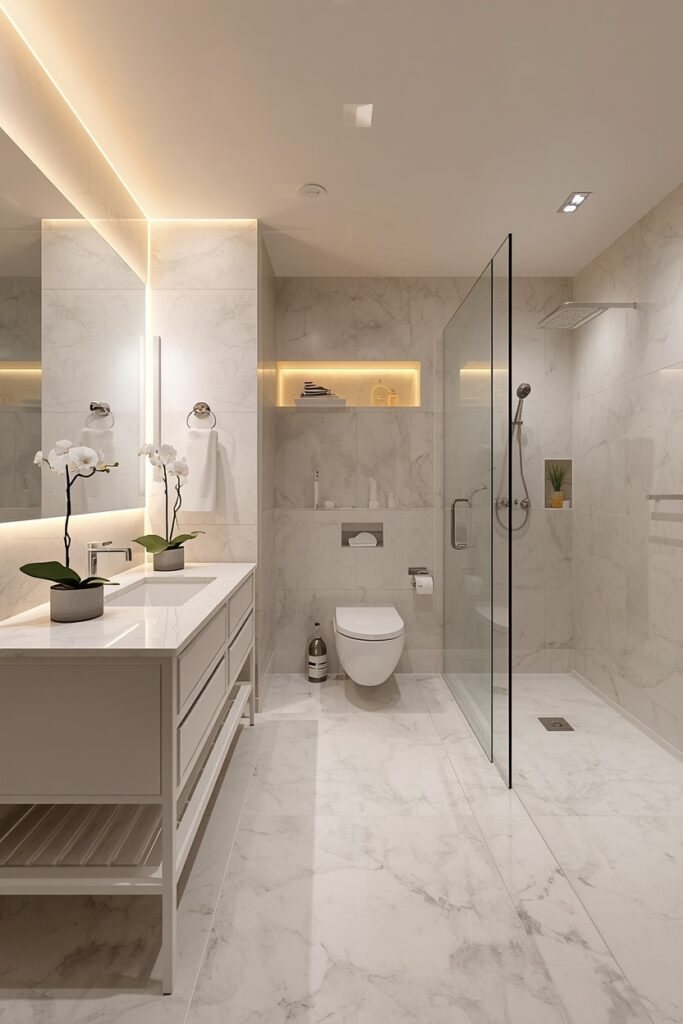
Carrara marble gives you the softest, most forgiving marble master bathroom, with pale gray feathering instead of bold veins. Take it wall to wall in a compact ensuite to make a small footprint read larger, then keep every fixture white or chrome so the room stays quiet and bright. A frameless glass shower and a wall-hung vanity preserve sightlines to the floor, which is the trick that makes a tight space open up. Carrara is softer and more porous than Calacatta, so it etches more easily around basins — a honed surface hides this far better than polished.
For a genuinely low-maintenance version, I sometimes pair real Carrara walls with a porcelain marble-look floor that shrugs off daily wear.
4. Nero Marquina Black Marble Drama
Nero Marquina is the black marble with crisp white veins, and it turns a master ensuite into a jewel box the moment the lights go low. Use it as a full feature wall behind a freestanding tub, then keep the remaining walls soft white so the black does not close the room in.
White marble mosaic on the floor and polished nickel fittings stop the scheme reading heavy. Black stone shows every water spot and soap film, so a daily squeegee and a matte-honed surface are non-negotiable if you want it looking sharp.
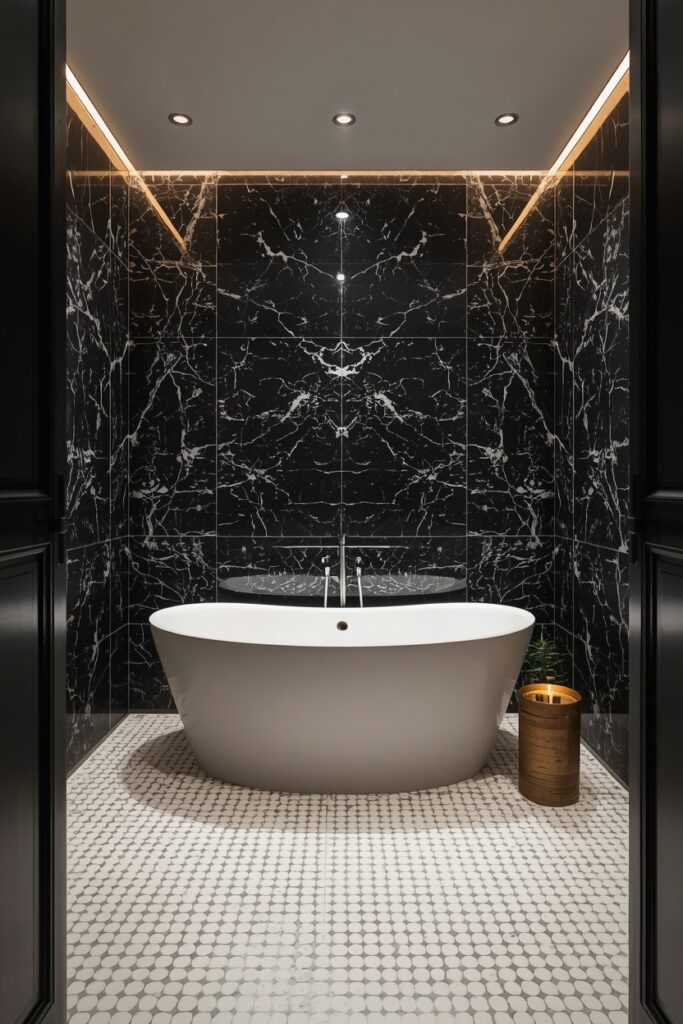
This is a bold, decisive choice — commit to it fully rather than dotting small black accents around, which just looks unresolved.
5. A Book-Matched Slab Wall Behind the Tub
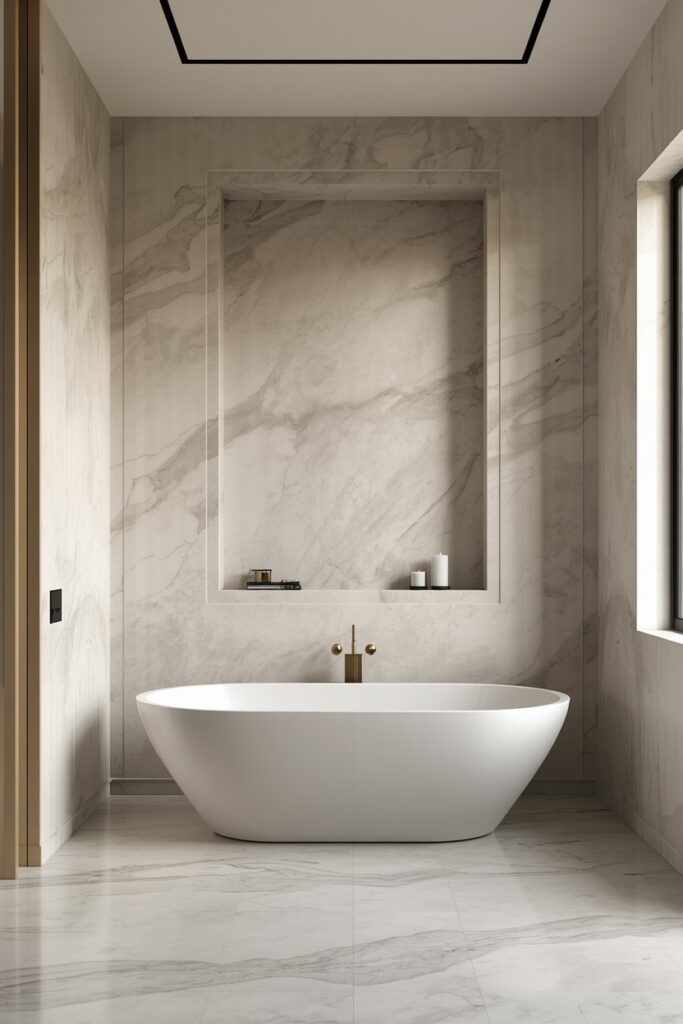
Nothing anchors a marble master bathroom like a book-matched slab wall rising behind a sculptural freestanding tub. Book-matching mirrors two adjacent slabs so the veining opens like butterfly wings, creating a natural focal point without a single accessory. Frame it simply: a floor-mounted tub filler, a slim shelf for a candle, and nothing else on that wall. Ask your fabricator for a slab layout drawing before cutting, because book-matching only reads right when the two slabs are sequential from the same block. It is a splurge, but a single dramatic wall lets you use a cheaper tile elsewhere and still get the wow moment.
6. Art Deco Marble Bathroom in Brass and Stone
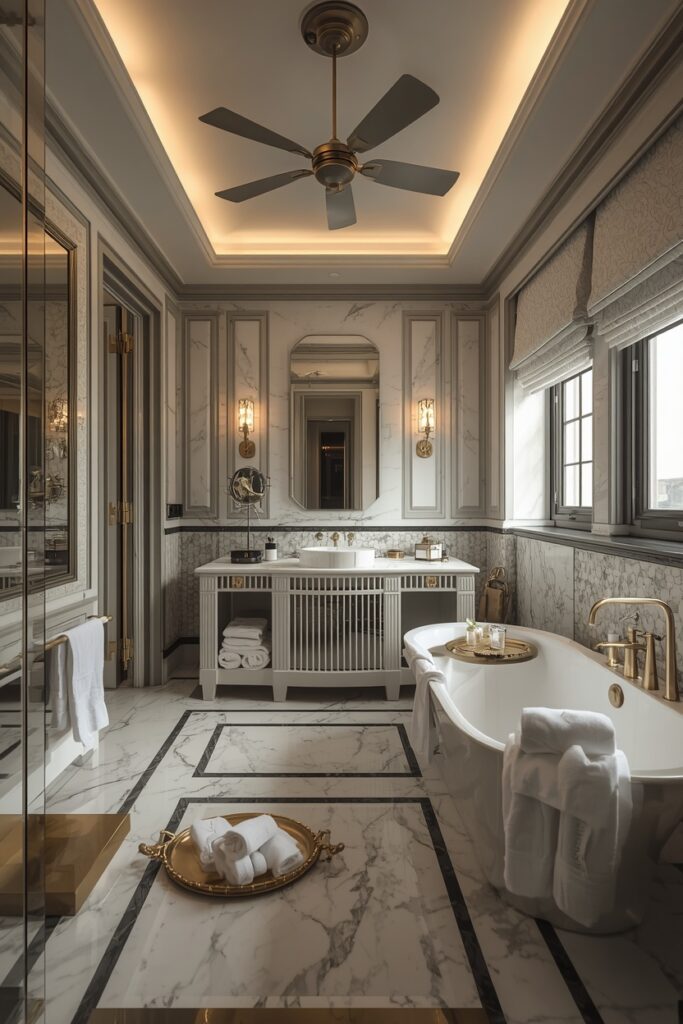
For an ensuite with real character, lean into Art Deco with marble, brass, and strong geometry. Think fan-shaped mosaic behind the vanity, a fluted marble tub surround, and slim brass inlay strips set into the floor stone. A palette of warm white marble, black accents, and aged brass keeps the era reference refined rather than costumey. The detail that sells it is symmetry: paired sconces, twin mirrors, and a centered vanity make the whole room read composed.
Keep the metal consistent — mixing brass with chrome here dilutes the Deco story fast.
7. Verde Alpi Green Marble with a Walnut Vanity
Green marble is having a real moment, and Verde Alpi — deep forest green shot through with white — brings rich, natural depth to a master ensuite. Set it as a vanity backsplash and shower wall, then ground it with a solid walnut vanity and unlacquered brass taps that will patina over time.
The three-tone palette here is green stone, warm walnut, and cream plaster, which reads organic rather than flashy. Green marbles are often serpentine-based and sensitive to water, so keep them out of constant-splash zones or seal them diligently.
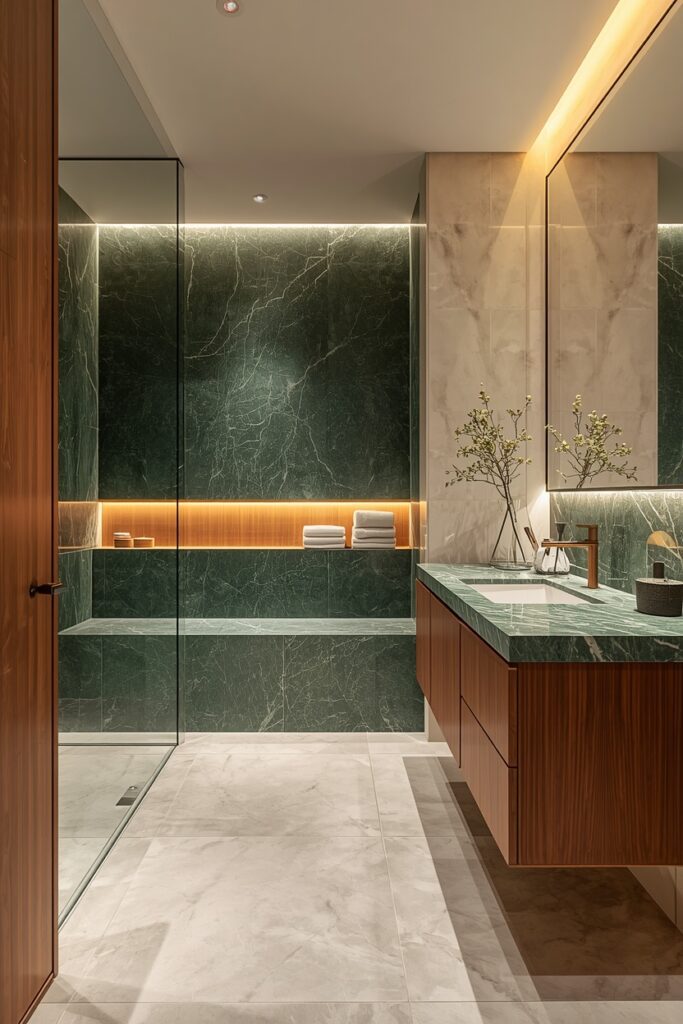
Used on a single wall, it delivers color and drama without the upkeep of a full green-stone room.
8. Rose Onyx Soft-Luxe Ensuite
Blush-toned onyx or rose marble gives a master ensuite a soft, romantic glamour that still reads grown-up. Pair the pink-veined stone with warm white walls, brushed champagne-gold fittings, and a curved vanity to echo the softness. Onyx is translucent and best used as a feature — a single vanity wall or shower niche — rather than underfoot, where it is too delicate.
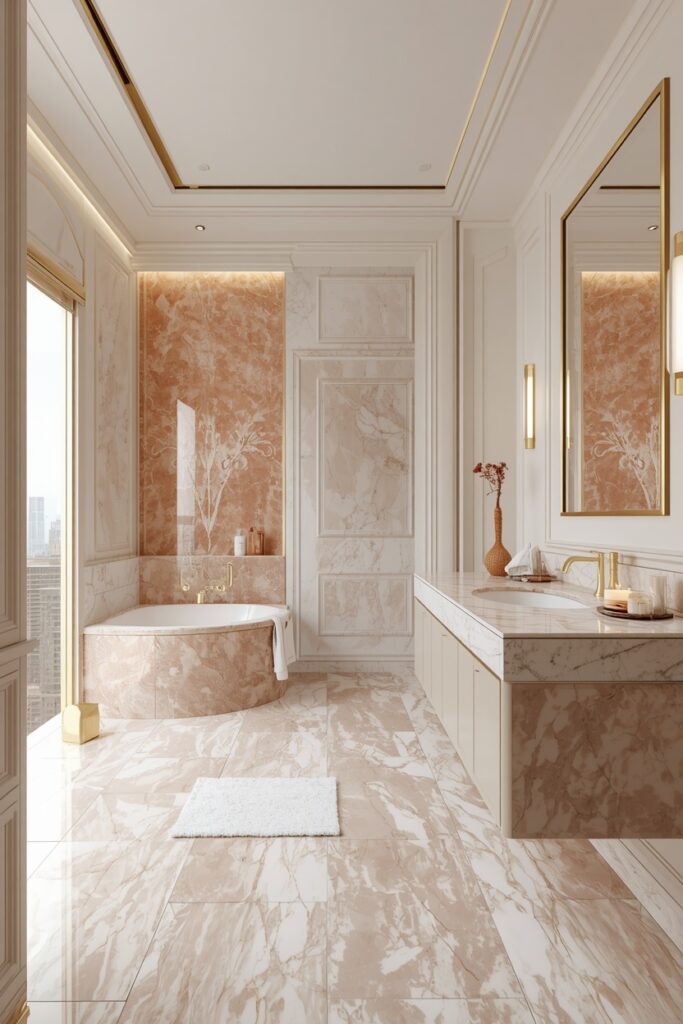
Keep textiles tonal, in oatmeal and blush, so the stone stays the star. This is the palette I recommend when someone wants glamour without the room turning into a jewelry box.
9. A Floor-to-Ceiling Marble Bathroom Shower
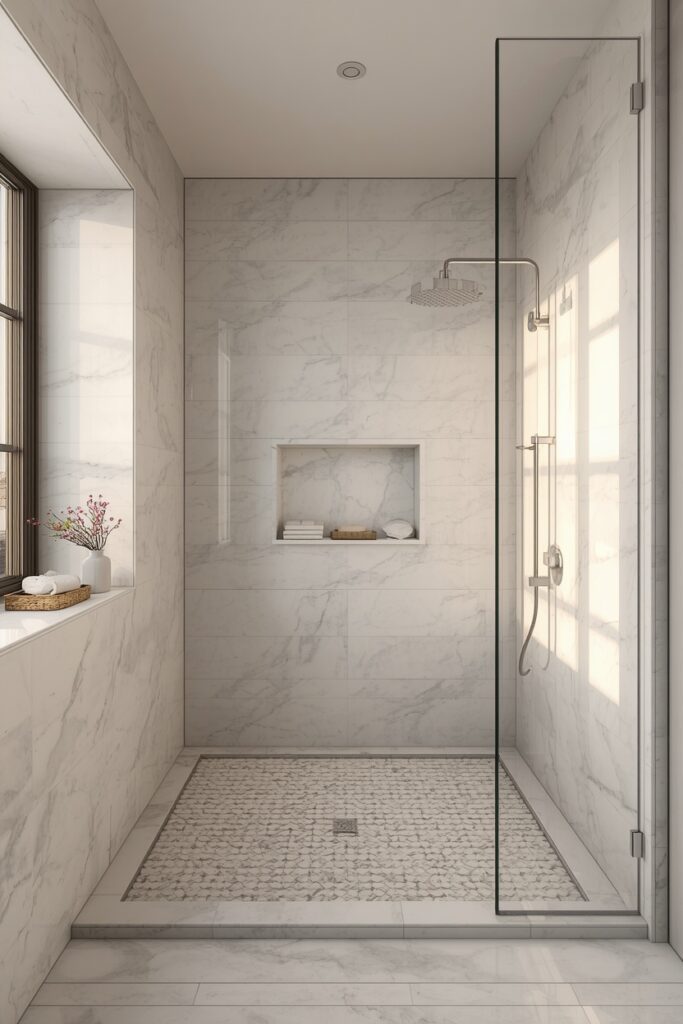
A walk-in shower lined floor-to-ceiling in large-format marble slabs is the most hotel-like move in this whole list. Fewer grout lines mean fewer places for mildew and a cleaner, calmer wall, which is why slab showers read so expensive. Add a recessed niche cut from the same stone, a rainfall head, and a frameless glass panel to keep the marble uninterrupted. The practical caveat: slabs are heavy and need a fabricator plus a strong wall substrate, so this is not a weekend DIY. If full slabs blow the budget, large 600x1200mm marble-look porcelain tiles get you most of the way with far easier upkeep.
10. His-and-Hers Double Marble Vanity
When the ensuite is large enough, a double vanity in a single run of marble is the layout that makes a master bath read as a retreat. Specify one continuous stone top with an undermount basin at each side, and a tall mirror above each to double the light. Storage matters more than looks here: deep drawers on soft-close runners beat cupboards for everyday use.
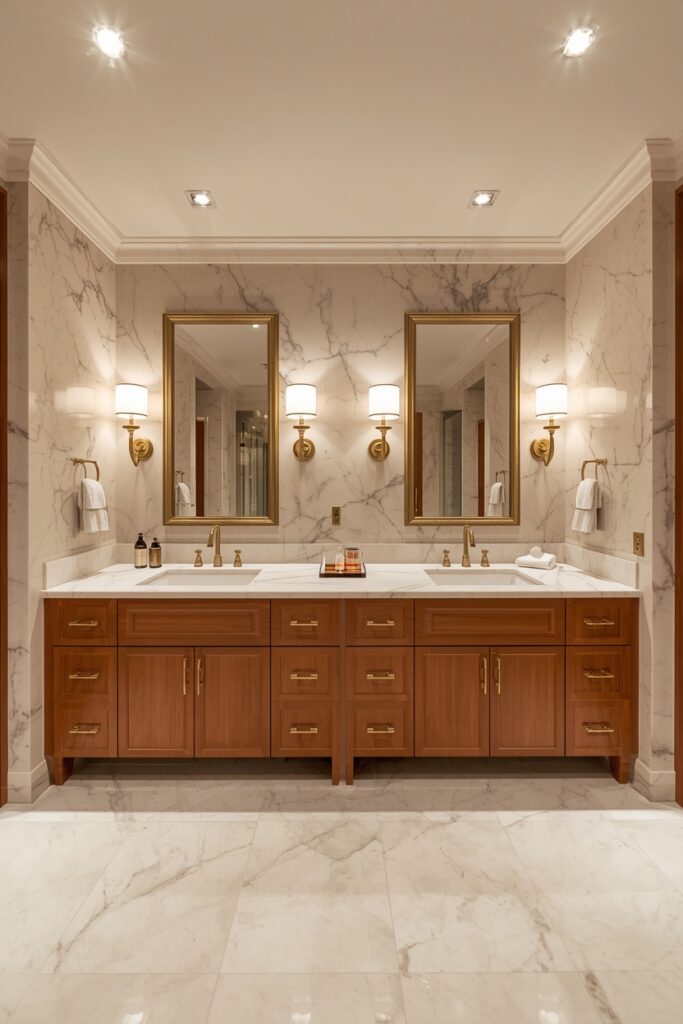
Book-match the slab across the backsplash if the wall is short enough — it turns a functional zone into a feature. Give at least 900mm per person so two people are not knocking elbows during the morning rush.
11. Heritage Marble Mosaic Floor
In a period home, a classic marble mosaic floor — hexagons, basketweave, or a simple black-and-white border — roots a master ensuite in its architecture. Pair the patterned floor with plain honed marble or plaster walls so the room does not get busy. This is where traditional detailing earns its keep: a marble skirting, a paneled bath surround, and a console basin all read authentic. Small marble mosaics carry a lot of grout, so specify a stain-resistant epoxy grout in a mid gray that will not show every footprint.
It is a period-appropriate look that also happens to be less slippery than large polished slabs.
12. Marble and Matte Black Modern Contrast
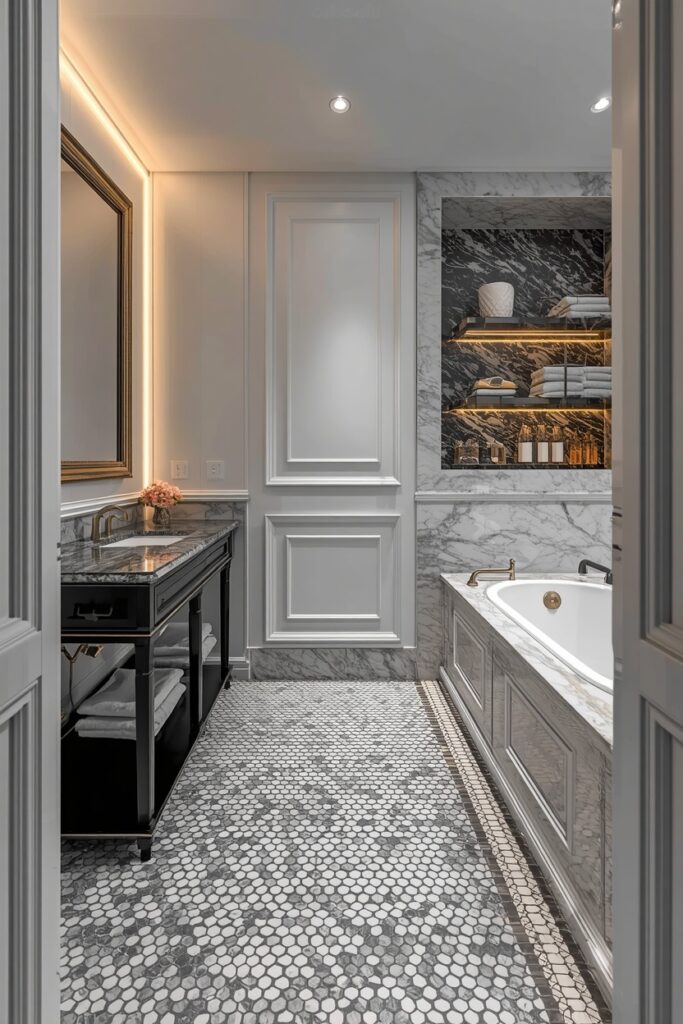
Crisp white marble against matte black is the cleanest way to give a marble master bathroom a modern, architectural edge. Keep the stone pale and quiet, then draw every line in black: matte black brassware, black-framed shower glass, and a slim black mirror.
The three-tone discipline — white stone, black metal, pale oak — is what stops contrast schemes looking harsh. Matte black taps show limescale and water spots in hard-water areas, so a water softener or a quick daily wipe keeps them looking sharp.
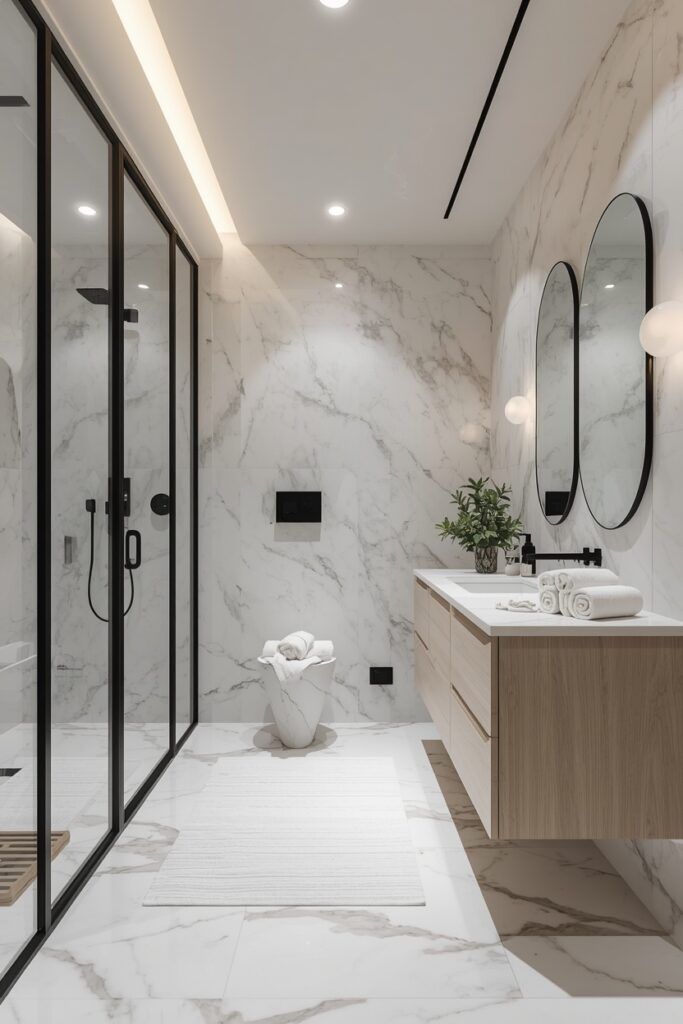
This palette photographs beautifully and stays timeless, which is why I reach for it so often.
13. Backlit Translucent Onyx Feature
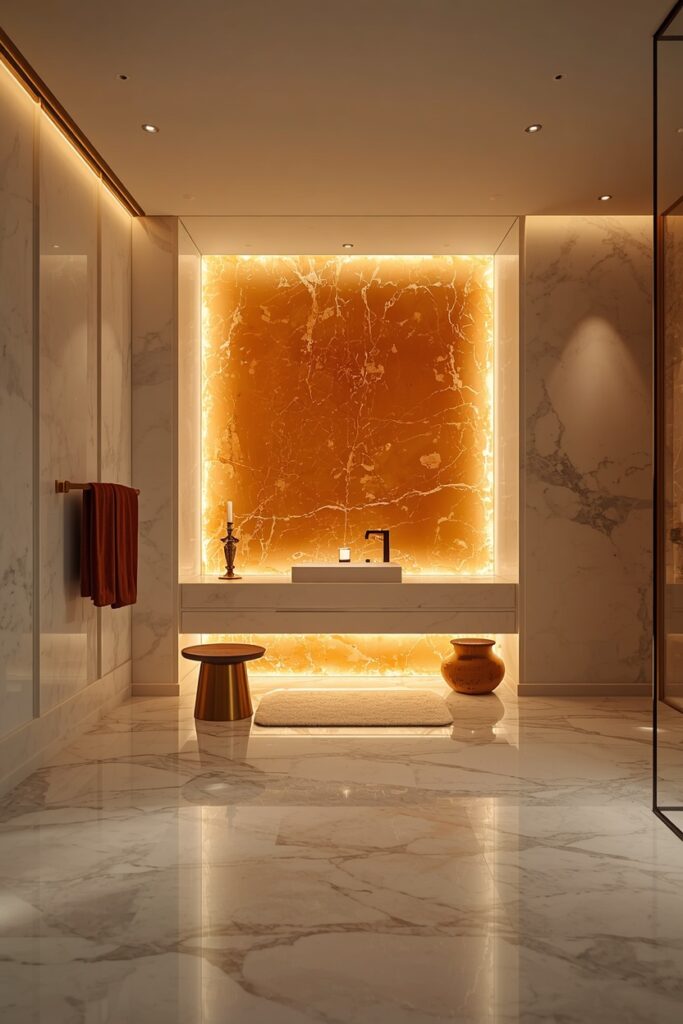
For genuine drama, a backlit onyx panel turns a slab of stone into a glowing light feature after dark. Onyx is translucent, so an LED panel set behind it makes the veining luminous — stunning behind a vanity or as a lit wall above the tub. Keep the rest of the room calm and warm-white so the lit stone stays the hero. This is a specialist install: you need an even, dimmable LED sheet and a stone thin enough to transmit light, cut and tested by a fabricator who has done it before. Treat it as a jewel and light nothing else brightly, or you lose the effect entirely.
14. Marble Wainscoting with Painted Walls Above
You do not need floor-to-ceiling stone to get the look — marble wainscoting to about 1.2m with painted plaster above is a smarter, calmer use of budget. The stone protects the splash-prone lower wall while the painted upper half softens the room and lets you add color. A muted sage, warm greige, or soft off-white above white marble keeps the scheme restful and grown-up.
Paint Picks: Above white marble, try Benjamin Moore White Dove OC-17, Sherwin-Williams Evergreen Fog SW 9130, Benjamin Moore Revere Pewter HC-172, or Sherwin-Williams Sea Salt SW 6204.

Cap the marble with a simple bullnose or a slim brass trim so the two materials meet cleanly. This is the version I recommend to most clients: much of the luxury for a fraction of the stone.
Where I’d Start if I Only Did Three Things
If I only did three things, I would start by choosing one hero stone and committing to a single book-matched feature wall rather than scattering marble everywhere — that one move buys most of the drama. Next, I would specify honed rather than polished surfaces and add underfloor heating, because honed marble hides etching and warm floors fix the one real complaint people have about stone bathrooms. Finally, I would lock the metal to a single tone — brass or nickel, not both — and let the veining be the only pattern in the room.
Frequently Asked Questions
How much does a luxury marble bathroom cost to build?
Costs swing widely with the stone and the scope. Natural marble like Calacatta and onyx sits at the top end, while Carrara and marble-look porcelain bring the price down substantially. The biggest levers are how much natural slab you use, whether you book-match, and your fabricator’s day rate for cutting and dry-laying. A smart way to control spend is one slab feature wall plus porcelain or painted plaster elsewhere, which delivers most of the impact for a fraction of the stone.
Is marble hard to maintain in a bathroom?
Marble is a calcium-based stone, so it etches when it meets anything acidic and stains if left unsealed. In practice, a honed surface hides etching far better than polished, and a penetrating sealer reapplied once a year handles daily use. Wipe spills promptly, use pH-neutral cleaners, and keep a squeegee in the shower. It is more upkeep than porcelain, but far less than people fear.
What is the difference between real marble and marble-look porcelain?
Real marble is natural stone with unique veining, genuine cool weight, and a translucency porcelain cannot fully copy. Marble-look porcelain is a printed, fired tile that resists etching and stains and costs less, but repeats its pattern and reads flatter up close. I often mix the two — real stone where you touch and see it, porcelain on high-wear floors.
Which marble color works best for a small ensuite?
For a compact ensuite, pale Carrara or a soft white marble reflects the most light and makes the footprint read larger. Run it wall to wall, keep fittings chrome or nickel, and use a frameless shower to hold sightlines open. Save dramatic dark marbles like Nero Marquina or Emperador for a single feature wall so a small room does not close in.
Final Thoughts
A luxury marble bathroom is less about how much stone you can fit and more about the discipline behind it — one hero marble, one honed surface, one metal, and a single moment that stops you at the door. Choose the stone that suits your light and your patience for upkeep, commit to it fully, and let the veining do the talking. Do that, and even a compact ensuite will read like the calmest room in the house.