

Walk into any bedroom and the first thing you actually register is the walls. Not the bed frame, not the nightstands, not the rug — the walls. They occupy more visual real estate than any single piece of furniture, and yet most bedrooms treat them as an afterthought: one coat of white paint, maybe a framed print, done. That gap between potential and execution is where these bedroom wall design ideas live.
Each of the nineteen concepts below treats the wall itself as the primary design element of the room. Some use texture, some use color, some use dimensional treatments like paneling or plaster. All of them turn a flat surface into something you notice the moment you step through the door. The furniture around them stays simple on purpose — when the walls carry this much character, the rest of the room can afford to breathe.
1. Limewash Plaster in Warm Terracotta
Limewash creates a depth of color that flat paint never achieves — the chalky, slightly mottled surface shifts under different light throughout the day, giving the wall an almost living quality. Apply a terracotta-toned limewash in overlapping cross-hatch strokes with a wide masonry brush for an organic texture that looks hand-done because it is. The variation in tone is the whole point, so do not try to even it out. Keep the remaining three walls in a warm off-white to let the limewash wall serve as the focal anchor behind the bed.
A low bed frame in light wood and linen bedding in cream and clay tones complement the earthiness without competing with it. One caveat: limewash is porous and can mark if furniture or headboards press against it, so leave a half-inch gap or mount the headboard directly to the bed frame rather than the wall.
Paint Picks: Portola Paints Roman Clay in Sonoran, Sydney Harbour Paint Co. Limewash in Terracotta, Bauwerk Colour Limewash in Grounded, Romabio Classico Limewash in Avorio tinted warm.

2. Floor-to-Ceiling Board and Batten Paneling
Board and batten paneling — vertical battens spaced evenly over a flat board base — adds architectural structure to a plain wall for a fraction of the cost of full millwork. Run the battens from floor to ceiling at 12-to-16-inch spacing and cap them with a simple baseboard and crown for a complete look. Paint everything in a single tone — the wall, the battens, the trim — so the depth comes from shadow lines rather than color contrast.
A moody dark green or charcoal grey makes a dramatic headboard wall, while a warm white or linen tone keeps the room bright and airy. The material cost for MDF battens runs about $2 to $4 per linear foot, making this one of the most affordable wall transformations available.
Paint Picks: Benjamin Moore Salamander (2050-10) for dark green, Sherwin-Williams Iron Ore (SW 7069) for charcoal, Benjamin Moore Simply White (OC-17) for bright white, Sherwin-Williams Alabaster (SW 7008) for warm linen.

Pair with a simple upholstered bed and minimal nightstands to let the paneling texture carry the room.
3. Hand-Painted Botanical Mural
A hand-painted mural of oversized botanicals — sprawling monstera leaves, trailing eucalyptus, or blooming magnolias — turns the headboard wall into a one-of-a-kind art piece that no wallpaper can replicate. Commission a local muralist or paint it yourself using a projector to trace outlines and then fill with acrylic-latex wall paint. Go with a muted palette — sage greens, dusty pinks, and warm greys on a pale cream ground — so the mural reads as sophisticated rather than childlike. Extend one or two branches or stems slightly onto the adjacent wall or ceiling for a wrapped effect that pulls the viewer into the scene. Keep furniture against this wall minimal: a simple bed frame, open nightstands, and no wall-mounted shelves or sconces competing with the artwork. Seal the mural with a clear matte varnish to protect it from scuffs and make future touch-ups easier.

4. Arched Wall Niche with Integrated Lighting
Carving a shallow arched niche into the wall behind the bed and lining it with a warm LED strip creates a sculptural focal point that doubles as ambient lighting. The niche depth only needs to be about three to four inches — enough to create shadow and dimension without eating into the room. Plaster the inside in a contrasting tone: a warm blush inside a white wall, or a deep navy inside a pale grey. The arch shape references classical architecture and softens the room’s geometry compared to a standard rectangular recess.

Center the bed within the arch so the shape frames the headboard like a built-in alcove, which makes even a simple bed look considered and permanent. Wire the LED strip to a dimmer so the niche glow can serve as a night light or a soft reading ambient at different intensities.
5. Textured Bedroom Wall Design Ideas with Venetian Plaster
Venetian plaster gives walls a polished, slightly reflective depth that reads as stone or marble from a distance and reveals handmade imperfection up close. Apply it in multiple thin layers with a stainless-steel trowel, burnishing each layer smooth before adding the next. The result is a surface that shifts between matte and sheen depending on the angle of light, which gives the wall an almost liquid quality after dark. Choose a warm neutral — pale sand, soft mushroom, or warm grey — for a treatment that ages gracefully and pairs with virtually any bedding palette.
Venetian plaster is durable once sealed, but the application process demands skill — each coat needs to be troweled at the correct pressure and angle, so this is a project where hiring a specialist pays off. The tactile quality of the surface makes it a particularly strong choice behind a floating headboard where the wall is partially exposed.

6. Dark Moody Gallery Wall
A gallery wall against a dark backdrop — deep charcoal, midnight navy, or forest green — creates a dramatic effect where the artwork appears to float in shadow. Paint the entire headboard wall in a deep matte tone and hang an asymmetric arrangement of framed prints, photographs, and small mirrors in thin gold or natural wood frames. Vary the frame sizes and orientations — mix portrait, landscape, and square — but keep all mats in white or cream for visual consistency across the collection. Start by placing the largest piece slightly off-center and building outward, maintaining roughly two inches of spacing between frames. This treatment turns the bedroom wall into a personal gallery that tells a story and adds more depth than any single piece of art could. The dark paint also hides nail holes and minor wall imperfections better than light tones, which is a practical bonus.
Paint Picks: Benjamin Moore Hale Navy (HC-154), Sherwin-Williams Tricorn Black (SW 6258), Behr Meteorological (N510-7), Benjamin Moore Essex Green (HC-188).

7. Woven Rattan or Cane Panel Accent
Mounting a large panel of woven rattan or cane webbing directly to the headboard wall brings a natural texture that wallpaper and paint cannot replicate. Stretch the cane over a slim wooden frame that spans the full width of the bed and mounts flush to the wall — the woven pattern catches light and shadow differently throughout the day. Choose a natural straw-toned cane against a white or warm cream wall for contrast, or pair bleached white cane with a pale grey wall for a softer, tonal look.
The cane panel replaces a traditional headboard entirely, which simplifies the room and frees up floor space. This treatment works especially well in bedrooms that lean toward coastal, Scandinavian, or minimalist aesthetics because the material adds warmth without ornamental fussiness.

One downside: natural cane is delicate — keep it away from direct sunlight that can dry and crack the weave over time, and consider a UV-protective spray.
8. Geometric Color-Blocked Walls
Painting bold geometric shapes directly onto the wall — oversized arches, diagonal color blocks, or stacked rectangles — delivers a graphic punch that turns the wall into art without hanging anything on it. Use painter’s tape for crisp edges and limit the palette to two or three colors plus the base wall color so the geometry reads as designed rather than chaotic. A large half-arch in dusty mauve behind the bed, extending from floor to about two-thirds up the wall, frames the sleeping area like a built-in alcove. Alternatively, try a diagonal split with warm terracotta on the lower half and soft cream above for a horizon-line effect that grounds the room.
Paint Picks: Sherwin-Williams Redend Point (SW 9081) for dusty mauve, Benjamin Moore Cinnamon (2174-20) for terracotta, Behr Blank Canvas (DC-003) for cream, Sherwin-Williams Evergreen Fog (SW 9130) for sage.

This technique costs nothing beyond paint and tape, making it one of the most budget-friendly wall transformations available. Remove the tape immediately after the final coat while the paint is still wet to get the cleanest possible edge.
9. Vertical Wood Slat Feature Wall
Vertical wood slats mounted to the headboard wall bring a warm, rhythmic texture that reads as modern and architectural. Use slats roughly 1.5 inches wide spaced about 1 inch apart, running floor to ceiling, in a natural oak, walnut, or light ash tone. Mount them on a dark-painted backer board — the shadow lines between the slats add depth and make the wall look three-dimensional under side lighting. The slat wall also provides an acoustic benefit, breaking up sound reflections in bedrooms with hard floors or minimal soft furnishings.
Extend the slats about 12 inches onto the ceiling for a wrapped effect that makes the wall read as an architectural element rather than an applied treatment. Pair with a low-profile platform bed and neutral bedding to keep the wood texture as the clear protagonist.

10. Soft Fabric Upholstered Wall
Wrapping the headboard wall in padded fabric — linen, cotton velvet, or bouclé — creates a surface that is visually soft, acoustically dampening, and genuinely luxurious to lean against. Stretch the fabric over thin foam batting mounted on plywood panels, and install the panels edge to edge across the full wall. Divide the wall into vertical or rectangular sections with slim brass or matching-fabric welting for a structured paneled look rather than a single unbroken sheet.
Choose a muted tone — oatmeal linen, stone grey velvet, or cream bouclé — so the texture carries the interest rather than a strong color. This treatment eliminates the need for a separate headboard since the wall itself becomes the padded surface.

The trade-off is maintenance: fabric walls attract dust and are harder to clean than paint, so vacuum them monthly with an upholstery attachment and treat stains immediately.
11. Oversized Wallpaper Mural for Bedroom Wall Design Ideas
A single oversized mural wallpaper — a misty mountain landscape, an abstract watercolor wash, or a faded botanical scene — transforms the headboard wall into something that reads as immersive rather than decorated. Choose a mural with soft edges and muted tones so it serves as a backdrop rather than competing with the bedding and furniture for attention. Peel-and-stick options are renter-friendly and removable, though paste-the-wall murals tend to lay flatter and show fewer seams in large-scale applications. Start hanging from the center of the wall outward to keep the focal point of the image centered behind the bed. Keep every other surface in the room deliberately plain — solid paint, simple bedding, unadorned nightstands — so the mural breathes. This is a case where the wall treatment does all the work and everything else just needs to stay out of its way.

12. Brick Exposure or Faux Brick Paneling
Exposed brick gives a bedroom wall an instant sense of history and raw texture that no manufactured material completely matches. If your home has brick beneath the plaster, exposing it and sealing it with a matte clear coat is the most authentic route — though the process is messy, time-consuming, and sometimes reveals brick that is too damaged or uneven to leave bare. Faux brick panels in a thin-cut real-brick veneer offer the same visual impact with far less disruption, and they mount directly over drywall with construction adhesive. Choose a warm red-tone or whitewashed brick depending on the mood: warm red for a loft-industrial look, whitewash for something softer and brighter.
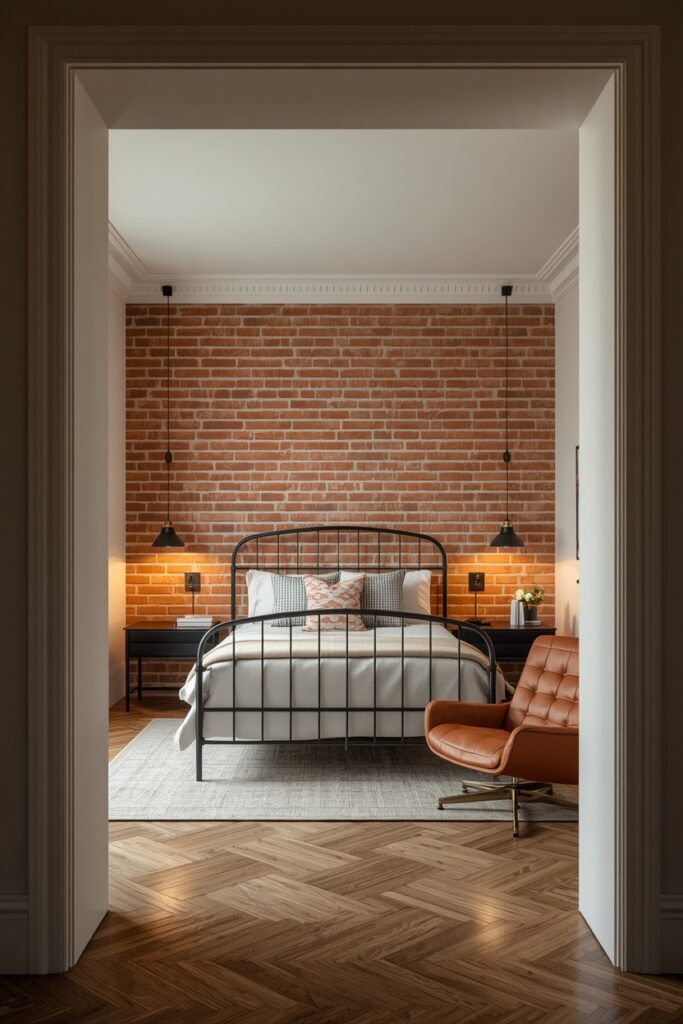
Either version pairs well with iron or matte black bed frames, warm leather accents, and simple industrial lighting. Seal exposed or veneer brick properly to prevent dust shedding — unsealed brick in a bedroom means grit on your pillows.
13. Half-Wall Paint Technique with Contrast Trim
Painting the lower half of the wall in a rich color and leaving the upper half in white or cream — divided by a slim picture rail or contrasting trim strip — creates a grounded, structured look that adds color without enclosing the room. The dividing line typically sits at about 48 to 54 inches from the floor, roughly chair-rail height, which is visually balanced and proportionally flattering in rooms with standard 8-foot ceilings. Choose a saturated but not overwhelming tone for the lower section: deep teal, warm olive, or dusty terracotta. The trim strip can be painted in a matte brass tone or a contrasting white for a clean break between zones.
This technique adds a sense of architecture to rooms with flat, featureless walls, and it directs the eye horizontally around the room, which makes the space read as wider. It is also far less intimidating than painting an entire room in a bold color since the upper white half maintains brightness and airiness.
Paint Picks: Sherwin-Williams Riverway (SW 6222) for deep teal, Benjamin Moore Cushing Green (HC-125) for warm olive, Behr Canyon Dusk (S210-4) for dusty terracotta, Sherwin-Williams Pure White (SW 7005) for the upper half.

14. Pressed Tin or Embossed Metal Panel Wall
Pressed tin ceiling tiles repurposed as a wall treatment behind the bed bring a reflective, dimensional texture that bounces light and adds period character in a single move. Choose tiles in a floral or geometric embossed pattern and mount them edge to edge across the full headboard wall. A brushed silver or antique brass tone works in most palettes, while a matte white pressed tin reads as architectural rather than metallic. These tiles are lightweight and mount with construction adhesive or small nails directly into drywall. The reflective quality of tin catches and scatters lamplight in ways that matte surfaces cannot, which makes the room look more dynamic after dark. Pair with simple bedding and unadorned side walls so the tin texture stays the focal point without competing with other patterns or finishes.

15. Ombre Gradient Paint Effect
An ombre gradient — a single color fading from deep at the base to pale at the top — gives the wall a dreamy, atmospheric quality that flat color never achieves. Start with the saturated tone at floor level and blend it progressively lighter as you move upward, transitioning into the ceiling color for a seamless flow. Use a large damp roller to blend the wet edges between zones while the paint is still workable — you have about 15 minutes per section, so plan to work in vertical columns and blend as you go.
Dusty blue fading to white, sage fading to cream, or mauve fading to blush all create a twilight softness that reads as calming and immersive. This is a one-wall treatment — doing all four walls in ombre overwhelms the room and loses the dreamlike impact.
Paint Picks: Benjamin Moore Van Deusen Blue (HC-156) at base fading to White Dove (OC-17), Sherwin-Williams Evergreen Fog (SW 9130) at base fading to Alabaster (SW 7008), Behr Dusty Lilac (660E-3) at base fading to Cameo White (W-B-200).

Keep furniture minimal and avoid hanging art on the gradient wall so the color transition remains the visual story.
16. Stacked Stone or Ledgestone Accent Wall
A stacked stone veneer on the headboard wall brings raw natural texture that grounds the room with a lodge-like warmth no other material matches. Choose a natural ledgestone in warm greys and tans for a neutral palette, or a darker charcoal slate for a moodier look. Thin-cut stone veneer panels are 1 to 1.5 inches thick and mount directly to drywall with thinset mortar, keeping the installation manageable for a single accent wall. The uneven surface catches side light beautifully, creating shadow lines that shift as the day progresses.

Pair with warm wood furniture, soft wool textiles, and minimal metal accents to keep the room from reading too rustic or cabin-themed. One consideration: stone adds visual weight, so balance it with lighter tones on the remaining walls and ceiling to keep the room from closing in.
17. Layered Textile Wall Hanging for Bedroom Wall Design Ideas
A large-scale woven wall hanging — macramé, a kilim rug, or a hand-woven tapestry — adds color, texture, and acoustic softness to the headboard wall in a single portable piece. Choose a hanging that spans at least two-thirds the width of the bed so it reads as a deliberate design choice rather than a random accent. Hang it from a thick wooden dowel or a natural branch for a relaxed, handmade quality. The textile absorbs sound reflections off the wall behind it, which noticeably softens the room’s acoustics — a real benefit in bedrooms with hard flooring.
Pair the hanging with plain painted walls in a complementary neutral so the woven textures and colors stand out without competition. This approach is ideal for renters because it requires only a couple of wall hooks and leaves no lasting damage when removed.

18. Mirrored Panel Feature Wall
A wall of mirrored panels — antiqued, smoked, or plain — behind or opposite the bed doubles the perceived depth of the room and bounces light into every corner. Use beveled or seamed panels rather than a single sheet of mirror so the grid pattern adds architectural interest and avoids the gym-mirror look. Antiqued mirror with subtle clouding and foxing carries a vintage quality that reads as collected rather than utilitarian.
Position the mirrored wall so it reflects something worth seeing — a window, a statement light fixture, or a beautifully made bed — because it amplifies whatever sits opposite it, good or bad. The practical upside is dramatic: even a small bedroom reads as significantly more spacious with a mirrored wall.
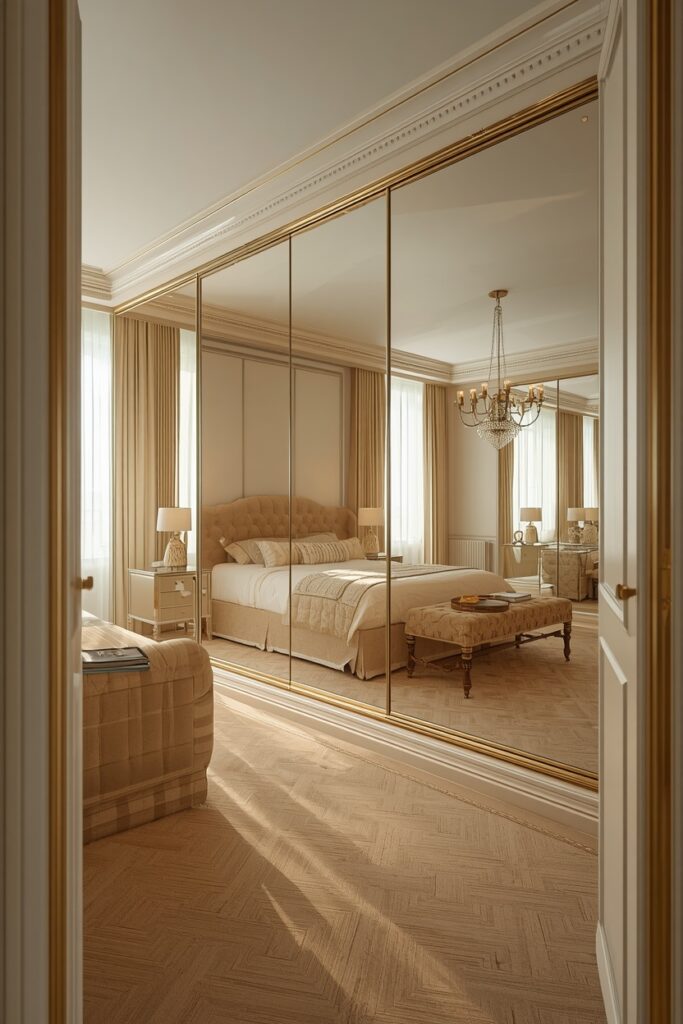
Clean the panels regularly with a glass cleaner and lint-free cloth because mirrored surfaces show every speck of dust in direct light.
19. Plaster Arch Surround with Recessed Bed Alcove
Building a plaster arch surround that frames the bed creates a built-in alcove effect that makes the sleeping area read as a room within a room. Construct the arch from lightweight drywall or plaster over a curved metal or wooden frame, extending it about 8 to 12 inches out from the wall surface. Plaster the arch and surrounding wall in a soft, matte tone — warm clay, pale mushroom, or soft ivory — and recess the wall behind the bed in a slightly deeper shade of the same color for depth. The arch references Mediterranean and North African architecture, which gives it a timeless quality that does not date with changing trends. Integrate a slim LED strip along the inner edge of the arch for a glow that outlines the shape after dark and serves as a soft reading light. This is a higher-investment project — framing, plastering, and painting require skilled labor — but the result is a permanent architectural feature that transforms the room entirely.

Where I’d Start if I Only Did Three Things
If I only did three things, I’d start with a limewash plaster treatment on the headboard wall in a warm terracotta or sand tone — nothing else transforms a flat wall into a textured focal point this quickly for this little cost. Second, I’d mount vertical wood slats on a dark backer board for an adjacent wall or closet zone, because the shadow lines and warmth they add change the entire spatial character of the room. Third, I’d install a slim warm LED strip around a simple arched frame above the bed to give the wall a sculptural glow that doubles as ambient lighting — it is a small build with outsized visual impact.
Frequently Asked Questions
What are the most impactful bedroom wall design ideas for a quick refresh?
Three treatments deliver the biggest change with the least disruption. A limewash or color-wash paint technique transforms the headboard wall in a weekend with no construction. A large-scale wallpaper mural goes up in a few hours with peel-and-stick options and creates a completely different atmosphere. A geometric color-block paint job using painter’s tape costs only a can of paint and an afternoon. All three are reversible or paintable, which makes them low-risk as well as high-impact.
How do I choose between paneling and wallpaper for a bedroom accent wall?
Paneling adds physical depth, shadow lines, and architectural structure — it changes how the wall reads from every angle and adds a tactile dimension that wallpaper cannot. Wallpaper excels at pattern, color, and scene-setting — it can introduce imagery, gradient, or detail that paneling’s flat planes do not support. If your room lacks architectural character (flat walls, simple trim), paneling gives it bones. If the architecture is already strong but the room lacks visual personality, wallpaper adds the narrative layer.
Can I combine multiple wall treatments in one bedroom?
You can, but limit yourself to two treatments maximum and keep them on different planes — one on the headboard wall and one on a side wall or ceiling. Combining a wood slat wall behind the bed with a half-wall paint technique on the adjacent wall creates depth without clashing. Avoid putting two bold treatments on facing walls, which creates visual competition and makes the room read as busy rather than layered. The safest pairing is one textural treatment (wood, stone, fabric) with one flat treatment (paint, limewash, color block).
Are peel-and-stick wall treatments durable enough for a bedroom?
Quality peel-and-stick wallpaper from brands with strong adhesive formulations lasts two to four years in a bedroom environment without peeling or curling at the edges. The key is wall preparation: clean the surface thoroughly, prime it if the paint is matte or chalky, and apply the panels at room temperature above 65 degrees Fahrenheit. Avoid using peel-and-stick products on textured walls like knockdown or orange peel — the adhesive needs a smooth surface to bond properly. In humid climates or bathrooms, paste-the-wall options hold more reliably long term.
Final Thoughts
Every bedroom wall is a blank surface waiting for a point of view. These bedroom wall design ideas run from zero-cost paint techniques to full architectural plaster arches, so there is an entry point at every budget and skill level. The common thread is treating the wall as the room’s primary design element — not a backdrop, but the main event. Pick the treatment that matches your space, your commitment level, and the atmosphere you are after, and let the furniture play a supporting role for once.